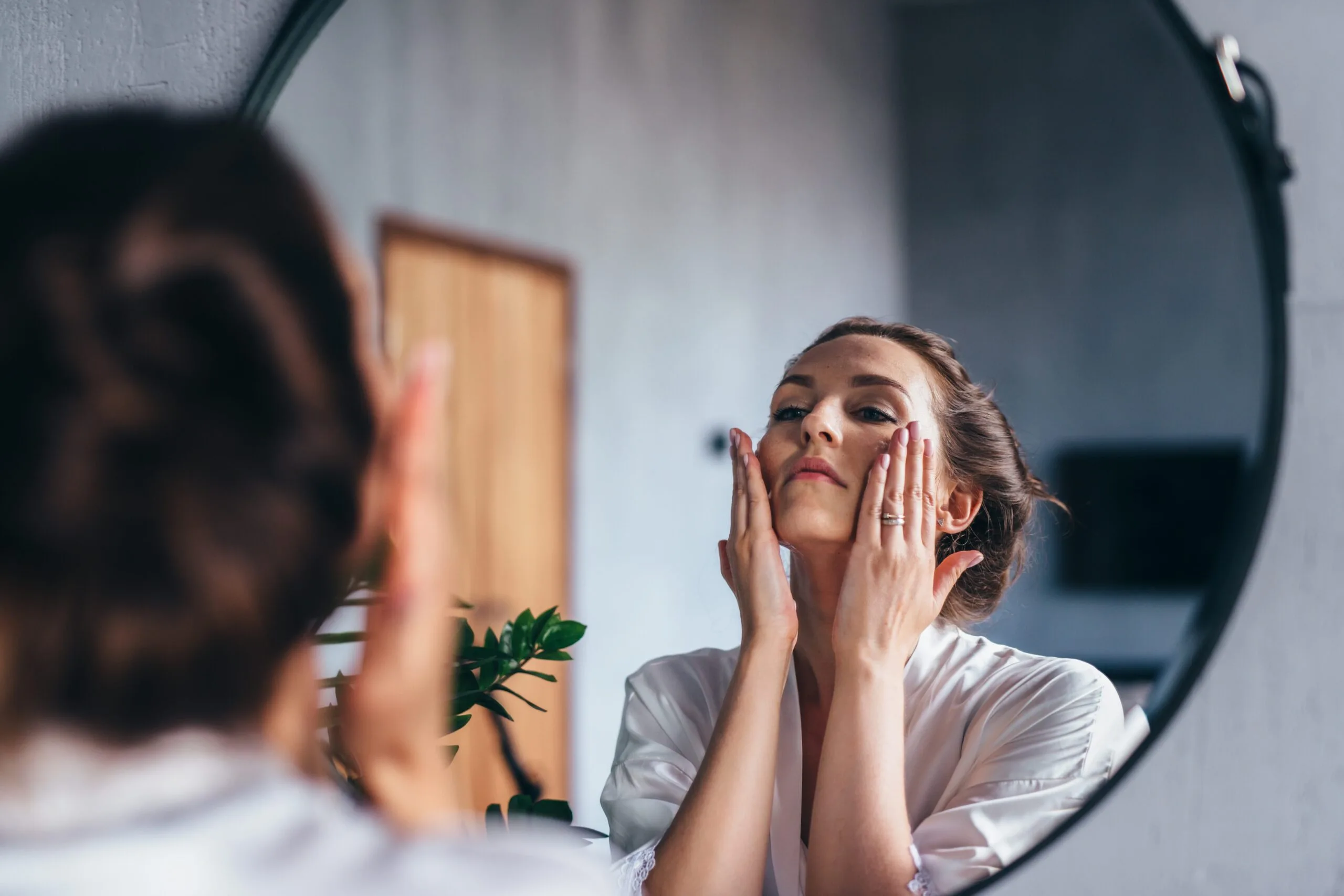

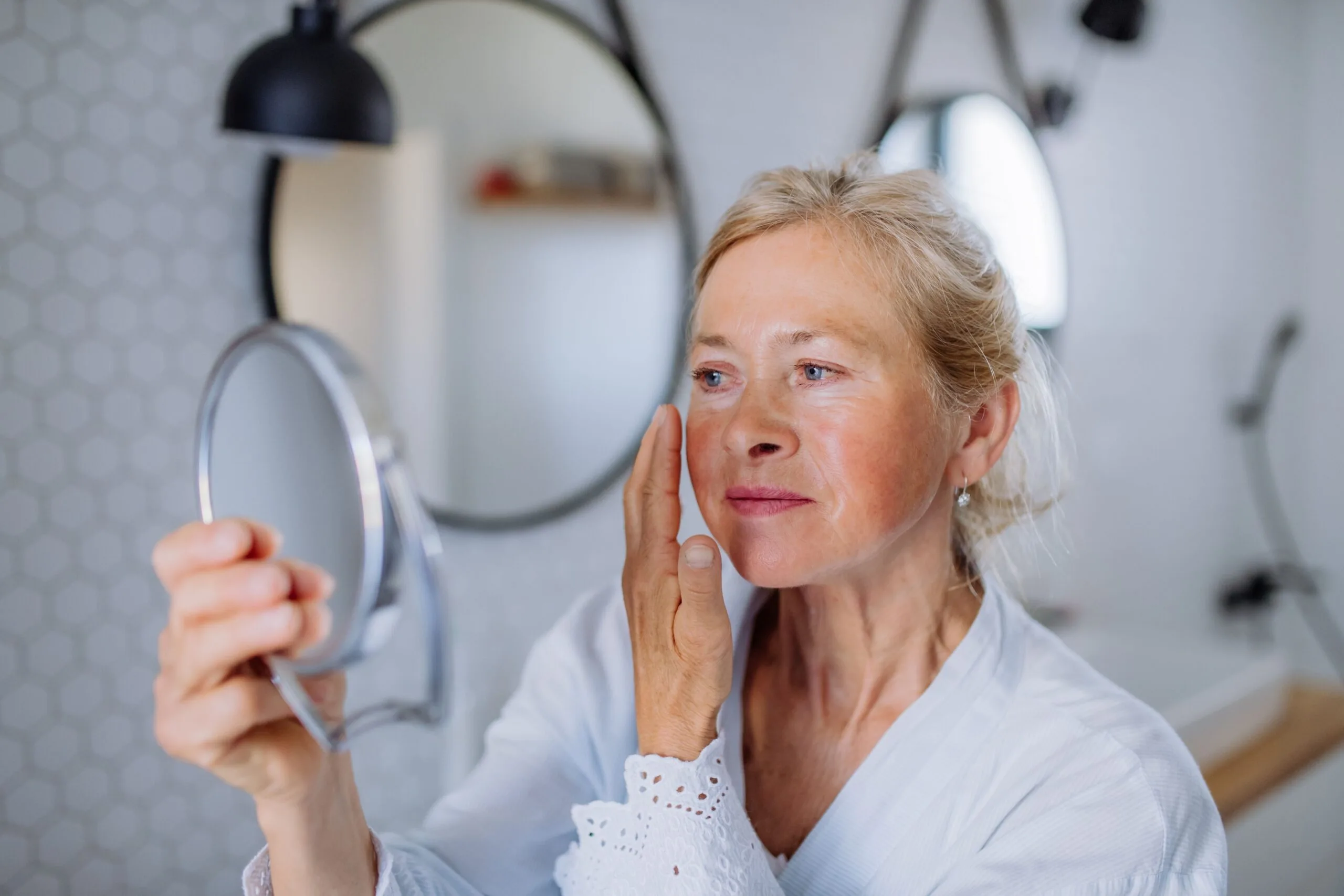
She noticed it while trying to get a contact lens out. Her hand was already wet, one eye watering, the bathroom light far too bright for that hour of the morning. She leaned towards the mirror, holding the lower lid down with one finger, and then stopped. It wasn’t because of the lens, it was because, from that close, she could see the unevenness in the skin beneath her eye and across the top of her cheek.
There was a small patch she had been meaning to look at properly for months. From a normal distance, it disappeared into the rest of her face. In the mirror that morning, with her nose almost touching the glass, it seemed suddenly obvious. She tilted her head one way, then the other. The patch stayed.
She straightened, blinked a few times and went back to searching for the contact lens.
That was perhaps the more honest response than panic. The day had already begun making demands before she had finished looking at her own face. Yet the moment stayed with her because it belonged to a category of changes that seemed to arrive without an appointment. Things she might once have dismissed as temporary were beginning to feel less temporary.
The temptation, at that point, is to intervene. There is always something new to try. The bathroom shelf can become a record of every concern she has noticed about herself.
By midlife, the question is no longer simply how to make skin brighter, but how to care for skin that is changing in several directions at once without treating every change as a problem.

When Familiar Skincare Stops Feeling Familiar
For years, skincare can operate almost like muscle memory. Cleanse, apply serum, and moisturize. Add something for whatever concern has appeared that month. Perhaps exfoliate, use a retinoid, and sunscreen in the morning. The sequence becomes so ordinary that it is easy to forget that skin itself is not static.
PURELY BELLA describes its Flawless Niacinamide Brightening Moisturizer as being formulated specifically with perimenopausal skin in mind, skin experiencing dark spots, uneven tone, dullness and increased reactivity. The product is positioned not simply as a brightening cream, but as a treatment moisturizer intended to combine those functions in one step.
That distinction matters because the problem with an increasingly complicated routine is not necessarily the number of products sitting on the bathroom shelf. It is the number of demands being placed on skin at once.
A woman notices pigmentation, so she adds a brightening serum. Her skin becomes dry, so she adds another moisturizer. Texture looks uneven, so an exfoliant appears. Fine lines become more noticeable, so another active enters the rotation.
Mature Skin Does Not Need to Be Treated Like a Project
There is a cultural habit of treating visible signs of ageing as problems requiring increasingly sophisticated intervention. A spot becomes something to erase. Dullness becomes something to correct. Texture becomes something to smooth away. Every new line is an instruction to add another active.
Mature skin may need a routine that acknowledges what is happening simultaneously: pigmentation alongside dryness, uneven tone alongside sensitivity, and the desire for visible improvement alongside a growing awareness that irritation can make everything look worse.
What is interesting about the formula is not simply how many ingredients it contains, but what they suggest about the way mature skin is being approached. Rather than isolating pigmentation as a single problem to correct, PURELY BELLA brings together 5% niacinamide, 3% tranexamic acid, kojic acid and glucosamine, ingredients the company says target different pathways associated with the appearance of pigmentation and uneven tone. In that sense, the formula reflects a more layered understanding of changing skin: that uneven tone may exist alongside dryness, sensitivity and a complexion that no longer responds to products quite as predictably as it once did.
The Appeal of One Less Decision
There is another reason simplicity becomes attractive in midlife that has little to do with skincare science. There are simply more decisions. The days are full. Work, family, relationships, ageing parents, children becoming independent, changing bodies, changing priorities. The fantasy of a beautifully organized ten-step evening ritual can be appealing, but the reality of standing at the bathroom basin at 10:47 p.m. is often less elegant.
PURELY BELLA positions Flawless as a day treatment and night moisturizer, with directions calling for one to two pumps after cleansing and water-based serums in the morning, followed by broad-spectrum SPF 30 or higher. At night, it can be used as the final treatment moisturizer, either alone or beneath a richer barrier cream if needed.
It is not revolutionary to combine hydration and treatment. What feels contemporary is the recognition that a routine must fit into an actual life.


Brightening Needs a Softer Definition
The word brightening has acquired a certain urgency. It can imply correction or erasure. A promise that skin should become clearer, lighter, smoother, somehow returned to an earlier version of itself, but there is another way to understand brightness.
Healthy-looking skin catches light differently. Hydrated skin can appear more supple. A more even-looking complexion can seem rested even when the person wearing it is not. Texture, moisture and tone are connected in the way the face is perceived.
Alongside its brightening ingredients, Flawless contains glycerin and urea for moisture, as well as an antioxidant complex including astaxanthin, green tea leaf extract, stable vitamin C and tocopherol. The formula is fragrance-free and contains no essential oils or retinol, according to the company.
The omission of fragrance is particularly relevant to the product’s positioning around changing, more reactive skin. It is an easily overlooked detail because fragrance is often associated with pleasure in skincare, but when skin becomes more easily irritated, what is left out of a formula can become as significant as what is added.
Why Astaxanthin Keeps Appearing in the Conversation
Astaxanthin is an ingredient that still feels slightly unexpected among the more familiar names of vitamin C, retinol and niacinamide. PURELY BELLA includes it in the antioxidant component of Flawless, alongside stable vitamin C, green tea extract and tocopherol. The company highlights astaxanthin for its antioxidant properties and its role in helping skin deal with oxidative stress associated with environmental exposure.
The conversation is no longer only about what is already visible in the mirror, such as a dark spot, uneven tone or fine line, but about the conditions skin encounters every day: sunlight, pollution, oxidative stress and the cumulative effects of the environment. The emphasis shifts subtly from correction to resilience.
When the skin is changing, care cannot always be reduced to making one concern disappear. There is the pigment already present on the cheek, but there is also the daily environment in which that cheek exists. Skincare becomes about creating conditions in which the skin can remain comfortable, supported and healthy-looking over time.

The Patience Problem
Much of the beauty industry has trained consumers to expect immediacy. A product is supposed to feel active, produce a visible sensation, or offer some indication that something is happening. Pigmentation, however, is not a problem created in a week, and it cannot reasonably be expected to disappear at the snap of the fingers.
PURELY BELLA recommends introducing Flawless gradually, beginning with every other morning during the first week and moving to every morning in the second week if the skin remains comfortable. The company also recommends patch testing first and introducing other new products one at a time.
The company’s product page reports an eight-week consumer study in which 97% of participants saw a brighter complexion, 95% felt more hydrated and 92% saw smoother skin after twice-daily use. Those figures are self-assessed, brand-reported consumer results rather than independent clinical findings, but they underline the timeframe the company associates with consistent use.
Eight weeks is long enough to establish a routine.
The Experience Behind the Formula
There is a practical logic behind this less-is-more approach. PURELY BELLA products were formulated by Cathi Carrier, a licensed esthetician and certified health coach with 32 years of experience in practice. The company’s philosophy is rooted in what she observed in treatment rooms: that skin changes, and approaches that once worked may not always make sense at another stage of life. Its premise is that perimenopausal skin deserves to be considered on its own terms.

The Skin She Has Now
The next time she stands in front of the bathroom mirror, she may still lean closer. The patch will probably still be there. So will the lines beside her eyes, the slight unevenness around her mouth, the details that become visible when the light hits from the side, but perhaps she will not examine them with the same urgency.
The contact lens will eventually be found, and the day will get on with itself. The face in the mirror will remain what it was that morning: not a problem to solve, but skin that has been changing for years.
The question was whether she could learn what her skin needed now. Sometimes that means brightening. Other times more moisture, patience, better protection from the sun, or doing less and allowing the skin to settle.
The mirror had shown her something familiar from an unfamiliar distance.