
There comes a point in your life where you start reading the back of the bottle. This isn’t because you’ve become an expert in cosmetic chemistry overnight, but rather because you’ve been using the same kinds of products for years; your skin has changed, and suddenly you’re left wondering what all these products are.
You find yourself with a cupboard full of products that you’ve only bought because they were recommended by social media. Your skincare collection becomes overcrowded over time, and you reach an age where anti-aging is something that you could find plastered all over the internet, even though no one really explains exactly what these ingredients are supposed to be doing.
The more you start to analyze the back of the bottle, the more confused you become.
Natural ingredients have slowly crept into the lives of many as an obvious choice. Clinical skincare is commonly associated with serious, results-focused decisions, particularly when it comes to highly researched active ingredients. But the conversation around natural vs clinical skincare is rarely as simple as choosing one side over the other. Natural and active ingredients are not opposing categories; instead, there is a space where natural and clinical skincare can meet through clean, high-performance actives. There is someone standing in the middle, trying to figure out what will actually work best for their own skin.
For many people, the real question is not whether one philosophy is better than the other, but how to choose skincare products when every bottle seems to promise something different.

A Place for Natural Products
The answer may depend less on whether an ingredient comes from nature and more on why it has been chosen, how it is used, and how it fits into the overall skincare formulation. Intrinsic’s natural origins came from a health-led approach to ingredient choice. As the brand evolved, its research and development focused on identifying clean, high-performance actives capable of delivering a more clinically focused approach to skincare without compromising those health-led formulation standards.
Natural ingredients have their place within a skincare routine, while clean, high-performance actives can offer a more clinically focused approach to formulation and performance. The two should not be treated as opposing philosophies.
What If You Didn’t Have to Pick a Side?
If you look at the gap between wanting to make intentional choices and wanting skincare that actually works, you’ll find a brand called Intrinsic Skincare.
Founded in 2024 by Nicky Hughes, the brand began with a health-led approach to ingredient choice and evolved through research and development into clean, high-performance actives. Hughes is also studying toward a Bachelor of Naturopathy, which provides further context for the health-first philosophy behind the brand.
Building on those natural origins, Intrinsic has developed its new range around clean, high-performance actives that can offer a more clinically focused approach to skincare while maintaining its health-first formulation philosophy.
Imagine you’re standing in a store with two different products in your hands. Neither seems to offer the full answer. While one product might have an ingredient philosophy that you prefer, the other contains the active ingredients that may be currently floating around social media. Something as simple as choosing a face serum can suddenly feel more complicated than it should.
The idea isn’t that you have to choose between natural and clinical skincare. It is about finding formulations that bring health-led ingredient standards together with clean, high-performance actives.
This is where Intrinsic’s approach to ingredient selection comes into focus. Its R&D has centered on identifying clean, high-performance actives that align with the brand’s health-first formulation philosophy and offer a more clinically focused approach to skincare.
What Are Active Ingredients in Skincare?
Generally, active ingredients are included because they are intended to perform a particular function within a formula. But their presence alone does not tell the whole story. Concentration, stability, delivery, and the overall formulation can all influence how a product performs.
This is the approach behind Intrinsic’s new range, which resulted specifically from R&D into clean, high-performance actives, with health remaining at the forefront of the brand’s formulation decisions. Instead of promising you eternal youth or simply misleading you to believe that aging is something that can be avoided, their goal is to help you better understand your changing skin and explore what evidence-based skincare may do when it comes to supporting a healthy, well-maintained appearance.
A Familiar Ingredient with More Going On
Vitamin C is probably one of the most well-known ingredients in skincare, and the vitamin C serum has become a familiar step in many routines. Yet there is still much to consider when looking at vitamin C for skin, including the form used, its stability, concentration, and the way it has been integrated into the formula.
L-ascorbic acid is one of the most studied topical forms of vitamin C and has been researched for many years. Research suggests that L-ascorbic acid can be unstable in certain formulations, particularly when exposed to factors such as water, oxygen, light, and heat.

Research has also explored topical vitamin C for its antioxidant properties and its potential role in supporting collagen-related processes in the skin. A systematic review that was published in the Journal of Cosmetic Dermatology suggests that topical vitamin C may have the potential to help improve the appearance of hyperpigmentation and wrinkles. However, there is also an emphasis on the need for more research into ideal formulations and concentrations.
Instead of just assuming that one formula will work for all, this brand created a system that looks at how different forms may be incorporated into your routine.
There’s a Reason the Powder Comes Separately
The Complete Vitamin C System combines a daily vitamin C serum with a 100% L-ascorbic acid powder that is mixed with the liquid Activation Booster immediately before use.

The Complete Vitamin C System includes the following:
- Daily Vitamin C Serum: a lightweight lipid serum containing 8% Tetrahexyldecyl Ascorbate (THD), squalane, and Vitamin E.
- L-Ascorbic Acid Activation Powder: 100% L-ascorbic acid powder.
- Activation Booster: a liquid used to dissolve the L-ascorbic acid powder immediately before application.
Keeping the 100% L-ascorbic acid powder separate from the liquid components allows it to remain in powder form until activation.
The choice to keep the powder separate from the serum is one of the most interesting features. Instead of storing the L-ascorbic acid in a water-based serum, it can remain separate until you want to activate it. This serves as a reminder that choosing an
Sometimes, Your Skin Just Needs Water
When considering skincare, most of the attention typically falls onto the latest trending ingredients rather than hydration. Hydration isn’t about delivering immediate results; however, it can still play a massive role in how your skin may appear and feel.
Consider well-hydrated skin. It usually appears smoother, plumper, and more comfortable. If you’re someone who is beginning to notice the early signs that their skin is starting to visibly change, hydration can be a simple but very important part of your daily routine.
Hyaluronic acid has been used in skincare for many years because of its water-binding properties, and research into hyaluronic acid for skin continues to explore its role in supporting hydration and the appearance of smoother, more supple-looking skin. Research published in The Journal of Clinical and Aesthetic Dermatology has reviewed the potential of topical hyaluronic acid and its role in supporting skin hydration and the appearance of aging skin. Results may vary depending on the molecular weight and formulation used.
Keeping Hydration Simple
Intrinsic’s 2% Hyaluronic Acid Serum has recently been added to the brand’s anti-aging range in new pump packaging while maintaining the original formula that customers are familiar with. Designed as a simple hydrating serum, it focuses on supporting hydration rather than overwhelming a routine with unnecessary complexity. It contains 2% hyaluronic acid and should be used on lightly damp skin before you apply any other products.
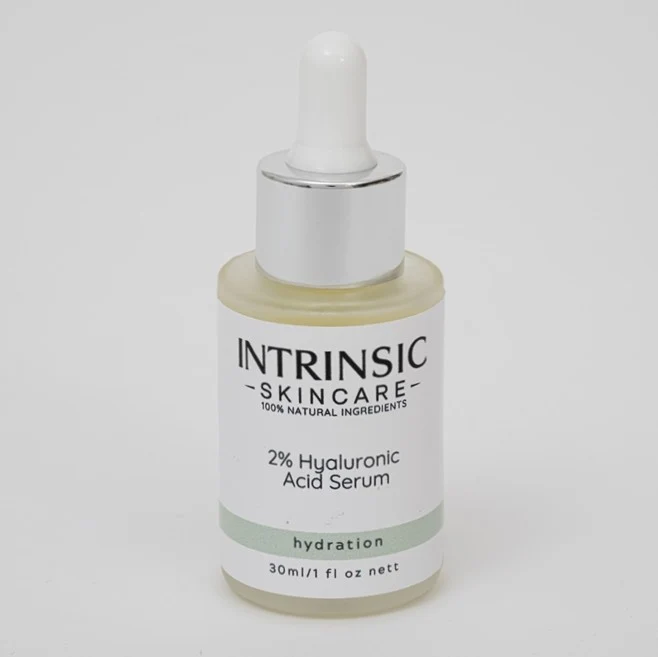
he 2% Hyaluronic Acid Serum features the following:
- 2% Hyaluronic Acid in the form of sodium hyaluronate.
- A formula designed to support skin hydration and a smoother, plumper-looking appearance.
- Jojoba Oil and Lactobacillus Ferment.
- A lightweight texture designed to layer with other skincare products.
- Instructions to apply it to slightly damp skin.
- A simple step suitable for shorter or more detailed routines.
Skincare that is simple typically gets overlooked because most people are looking for unrealistic overnight results. In reality, a hydration serum may be a useful foundation that could set the tone for the rest of your routine.
Can You Use Vitamin C and Hyaluronic Acid Together?
Another question that often comes up when building a routine is: can you use vitamin C and hyaluronic acid together? These ingredients serve different purposes within skincare. Vitamin C is commonly used in active formulations, while hyaluronic acid is often included to support hydration. Depending on the products and individual skin needs, they may be incorporated into the same routine according to product directions.

Not Just Another Bottle on the Shelf
At 54 and postmenopausal, the founder and formulator Nicky Hughes understands that skin changes as you get older, but aging is not a problem that needs to be solved. She believes that you should embrace the changes while still choosing products that can support hydrated, smooth, and healthy-looking skin.
Let’s go back to reading the back of the bottle. Why has that ingredient been used? What role does it play in the formula? And perhaps most importantly, does it make sense for your own skin and routine?
The Complete Vitamin C System and 2% Hyaluronic Acid Serum serve different purposes, with one bringing together clean, high-performance actives within a health-first formulation philosophy and the other focusing on hydration.
Ultimately, the conversation around natural vs clinical skincare may not be about choosing a winner. It may be about learning to look beyond the label and gaining a better understanding of the skincare ingredients you choose and why they are actually there. For Intrinsic, that means bridging natural and clinical skincare by combining a health-first formulation philosophy with clean, high-performance actives.