


The keys were already in his hand when he realized he had been standing beside the car for several minutes. He had finished the shift. The building behind him was still lit, but the car park had emptied out enough to make the silence noticeable. He looked down at the keys, then back at the entrance, trying to remember whether there was something he had forgotten. There wasn’t. He had simply stopped.
The strange part was that he wasn’t falling asleep. He could hear the air-conditioning unit humming above the doorway and feel the weight of the keys against his palm. He knew where he was and what he needed to do next.
What seemed to have gone missing was the small, automatic connection between one thing and another. A sentence gets read twice. A familiar task takes longer than it should. A decision that would normally require almost no thought suddenly feels like something that needs to be worked through.
Being awake, it turns out, is not quite the same as being fully present.

For the Days That Keep Going
Energy has become easy to consume. Coffee arrives in a cup, caffeine in a can, and another dose is rarely more than a few steps away. On a demanding day, the logic is understandable: if the first dose helps, another might help carry the afternoon.
A paramedic finishing a long night shift needs to stay attentive while making decisions that cannot be postponed. The corrections officer working through overnight hours may have to remain alert long after the body has begun asking for rest, while a parent finishing the day’s responsibilities after the children have gone to bed may still have work, studying or household tasks waiting.
The circumstances are different, but the underlying demand is familiar. Concentration has to hold. Patience has to last. Physical energy has to coexist with mental sharpness, sometimes long after the energy that arrived with the morning has begun to fade.
There are days when simply being awake is not enough. What matters is having enough mental presence to keep thinking clearly, remain engaged and move from one task to the next without feeling as though every decision has become heavier than it should.
This real-world tension ultimately shaped Thor’s Power™.
The brand was founded by James Nunalee, a North Carolina deputy sheriff and former corrections officer whose experience in law enforcement gave him firsthand knowledge of long shifts, interrupted sleep and environments where sustained attention matters. That experience became part of the thinking behind Thor’s Power™.
Rather than building another supplement around the assumption that more stimulation is always the answer, the brand approaches the question from a different angle: what might performance look like when the aim is to remain engaged throughout a demanding day?
The More-Is-More Trap
Caffeine has an understandable appeal on a long day. If 150 mg is useful, then surely 300 mg should do the trick?
This approach can turn a tired afternoon into a competition that no one wanted to enter.
Caffeine does, of course, play a role in alertness, but more does not mean better. At least not for everybody. Responses to high doses of caffeine may vary from person to person depending on a number of different factors, such as sensitivity, medications, and certain health conditions. The FDA generally states that up to 400 mg of caffeine per day is not generally associated with negative effects for most adults, although individual sensitivity can vary. FDA: Caffeine guidance
But there is research that looks beyond just caffeine alone.
A systematic review and meta-analysis of randomized controlled trials has examined combinations of L-theanine and caffeine. This review of findings suggests some short-term differences in attention and cognitive outcomes, although there is uncertainty around the size and direction of some findings. 2025 systematic review and meta-analysis
Combining these ingredients doesn’t guarantee a specific experience. There is no supplement that can simply replace good sleep, nutrition, hydration, or recovery.
Maybe energy doesn’t necessarily have to mean more stimulation. It might be useful to consider how different ingredients can be combined within a formula that is designed to focus on a particular kind of day.
Beyond Stimulation
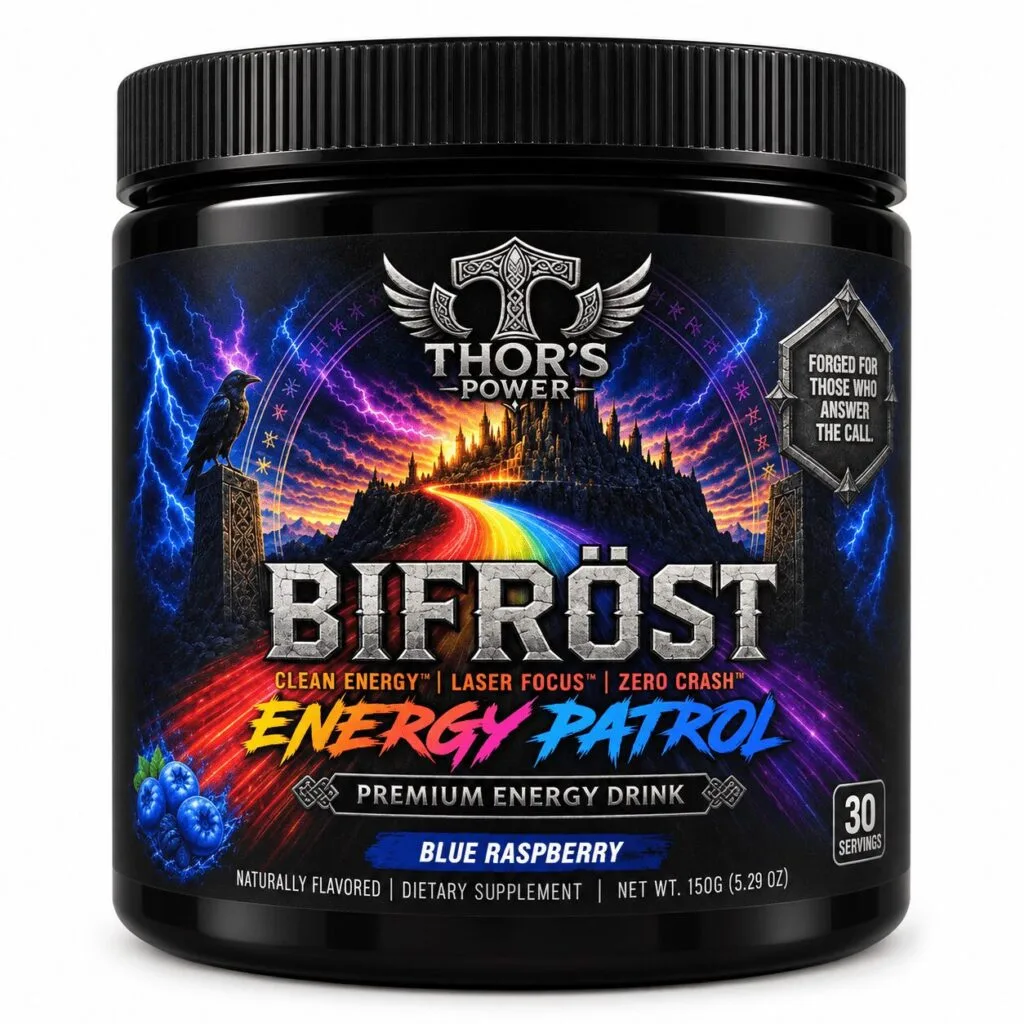
The Bifröst Energy Patrol™ formula sits within a broader understanding of what a demanding day can look like. It provides 150 mg of caffeine per serving alongside L-theanine, L-tyrosine, Alpha GPC, taurine, acetyl-L-carnitine, CoQ10 and rhodiola, bringing several ingredients together rather than relying on caffeine alone. The powdered format is mixed into a drink, placing it somewhere outside the traditional boundaries of a conventional pre-workout.
That distinction is worth considering because demanding days do not necessarily happen inside a gym. Physical and mental performance can be called upon in places that have nothing to do with training. It can be part of a long shift when attention has to remain steady, the final hours of a workday when concentration begins to thin out, or an evening when there is still studying, unfinished work or another responsibility waiting.

In those moments, the idea of performance becomes less about a single burst of intensity and more about what happens when the day keeps going.
The distinction matters. A pre-workout is traditionally associated with the hour before exercise, but not every demanding hour comes with a gym bag or a training plan. Sometimes the challenge is simply staying mentally engaged when there are still several hours left in the day.
The situations may look completely different on the surface, yet they share the same underlying problem: the body is still moving, the responsibilities are still there, and attention is being asked to last a little longer.
The Less-Than-Perfect Side of Wellness
Wellness is not always as perfect as a sunrise walk. It cannot always be defined by a green smoothie or a silent morning. Sometimes wellness means remembering to eat during the busiest of days, drinking enough water when your body hasn’t stopped moving, taking a break when one is needed, getting enough sleep, and knowing that supporting your energy goes hand in hand with giving your body what it actually needs.

The hours may look different from one person to the next, but fatigue often creates the same small disruptions. Sometimes a day demands more attention, patience and energy than expected. The answer is not always to push harder, add another stimulant, or treat exhaustion as something that simply needs to be overcome.
The morning will come. Eventually, the long shift will end, the laptop will close, the last task will be finished, and the house will become quiet.
The keys are in the hand. The car door opens. The next thing becomes obvious.
Being awake was never the whole point. It was having enough of yourself left to be present for what comes next.