
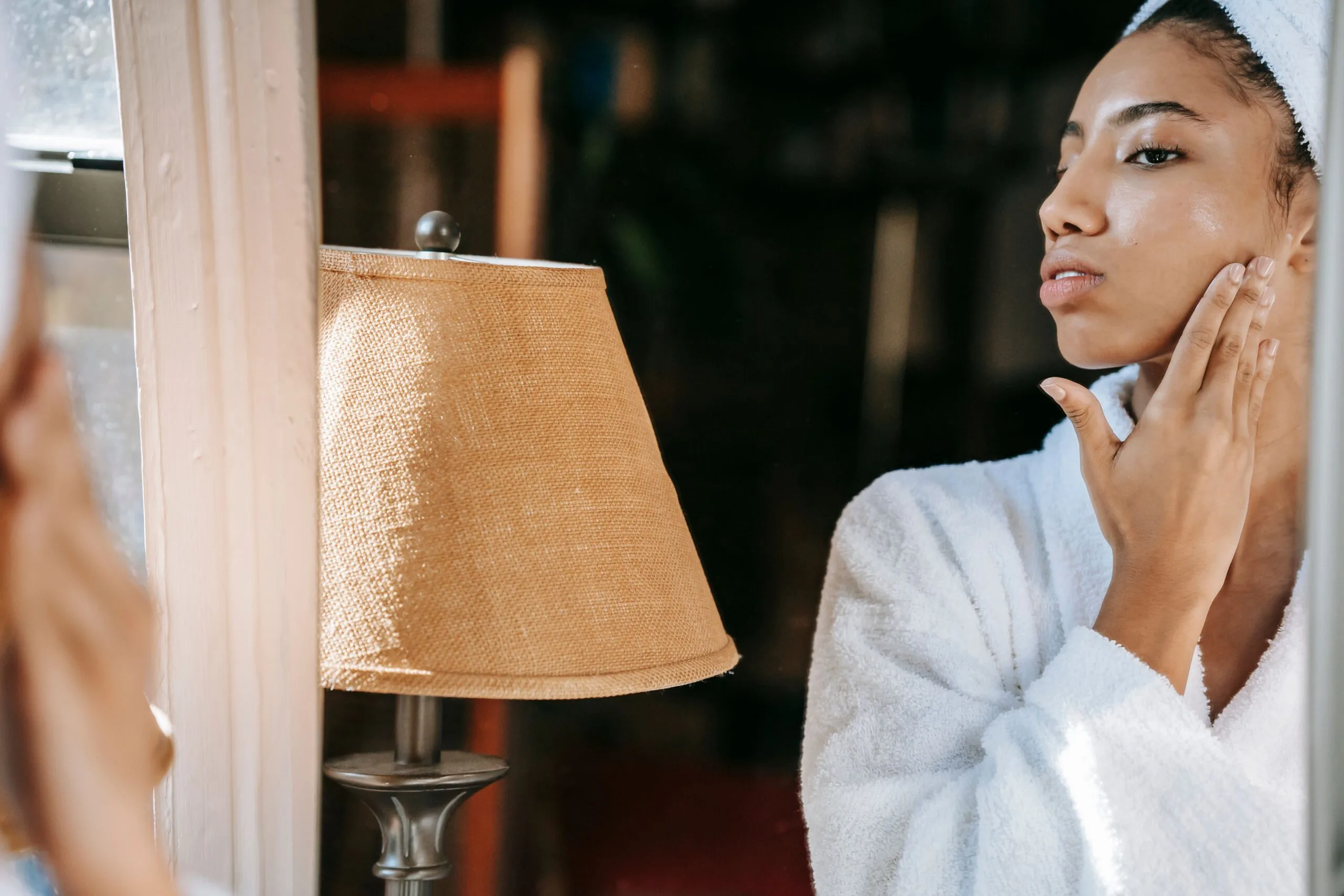
A few leftover candle ends were enough to make something useful. Instead of throwing them away, Sipiwe Andersons would collect them, melt them down and turn what remained into homemade creams. In another small act of resourcefulness, peanuts could be ground into a paste and worked over the skin, where the oils released during the process became part of the experience. The materials were ordinary, the process was hands-on, and the pleasure came partly from making something out of what was already there.
Years later, after moving into modelling and spending long hours under bright lights, with makeup applied and removed and the expectation of looking polished becoming part of the job, skincare acquired a different kind of importance. It had to withstand travel, schedules and repetition. The further Sipiwe moved into the professional beauty world, the more valuable those earlier lessons about simplicity and touch became.
That tension sits quietly behind many skincare routines. A bathroom shelf can hold serums, cleansers, brushes and creams, each with its own purpose, while a familiar sequence can be repeated almost without noticing it. The products may be carefully chosen, but the ritual itself can become another task to finish. Somewhere between the handmade routines of childhood and the highly developed beauty industry is another way of approaching skincare, one that asks for more attention to the act itself.
JS-Skin grew from that intersection of Sipiwe’s early experiences with handmade skincare and her years in the beauty and fashion industry. That history is still visible in the way JS-Skin approaches skincare, with a small number of products and an emphasis on touch.

The Five Minutes You Get Back
In 2023, a study published in the International Journal of Cosmetic Science compared a one-hour facial skincare session with a resting condition in healthy individuals. Both groups showed signs of relaxation; however, the group that took part in the skincare session showed greater relaxation across several physiological measures and a more positive emotional response. [Study link]
This was a small study and doesn’t mean that a skincare routine can be used as a way to treat stress.
The value of a routine can also be simpler than a particular cosmetic result: a few uninterrupted minutes spent doing something familiar, slowly enough to notice it.
What to Leave Out of the Routine
A simpler skincare routine does not necessarily mean replacing everything on the bathroom shelf. Sometimes it begins by paying attention to what is already there. Products that are used purely out of habit can make a routine feel longer without necessarily making it more useful.
A practical place to start is with the sequence itself. Cleansing, applying a treatment or moisturizer, and protecting the skin can provide a basic sequence. Exfoliation can then be added according to what the skin tolerates rather than simply because another step is available. Introducing several new products at once can also make it difficult to know which one is responsible if the skin becomes irritated. Keeping changes gradual makes the routine easier to understand.

The same principle applies to physical exfoliation. A brush does not need to be pressed firmly into the skin to feel effective and using it more frequently does not necessarily make exfoliation better. Dryness, sensitivity or irritation are useful reasons to pause and reconsider the approach rather than push through the routine.
There is also value in noticing what happens after a product is applied. Does the skin feel comfortable or tight? Does the texture suit the rest of the routine? Does a particular step genuinely add something, or has it simply become automatic? Those observations can be more useful than adding another product in response to every new skincare trend.
In that sense, simplifying skincare is less about having a smaller bathroom shelf and more about making each step earn its place there.
Brush First, Bottle Second
Together, the two products give the routine a clear physical beginning, moving from the brush to the botanical serum.
The Soft Facial Dry Brush has a wooden handle and 100% natural fiber bristles, and is intended for gentle use on dry skin before the rest of the routine. There is something tactile about beginning with an object rather than another bottle: the feel of the handle, the movement across the skin, the pause before the next step. In a routine that can easily become automatic, that physical beginning gives the process a little more presence.

When it comes to facial exfoliation, more pressure doesn’t necessarily mean better results. The American Academy of Dermatology highlights that mechanical exfoliation might be irritating for some people, especially those with dry, sensitive, or acne-prone skin, and it’s important to choose an approach that suits your skin type best. [Study link]
The Scudo Facial Serum follows with a different texture, bringing the routine back to the skin. The lightweight botanical formula combines jojoba and squalane with bergamot, frankincense, boswellia and immortelle. The result is a more emollient texture within an otherwise pared-back routine.
“Scudo” is the Italian word for “shield.” Sipiwe lived in Italy for a time, which is why she chose the word as a personal reflection of the idea behind the serum.
The Beauty of Not Doing the Most
There is something fitting about where Sipiwe’s skincare journey has arrived. The materials may have changed, from leftover candle ends and ground peanuts to a wooden facial brush and a carefully formulated botanical serum, but the hands-on quality remains. The routine still begins with touch. It still asks for a little attention to what is happening rather than simply moving from one step to the next.
The difference is that the bathroom now contains products made specifically for skincare. The Soft Facial Dry Brush prepares the skin with a simple physical gesture, followed by the Scudo Facial Serum and its combination of jojoba, squalane and botanical ingredients. Neither requires a complicated sequence. There is a brush, a few drops of serum, and enough time to notice the texture, the movement and the skin beneath the hands.
It is a long way from melting down candle ends, but perhaps not as far as it first appears. Both begin with the same instinct: to make something useful from what is available and to turn an ordinary act of caring for the skin into something worth paying attention to.
The bathroom may look different now. The ritual doesn’t have to.