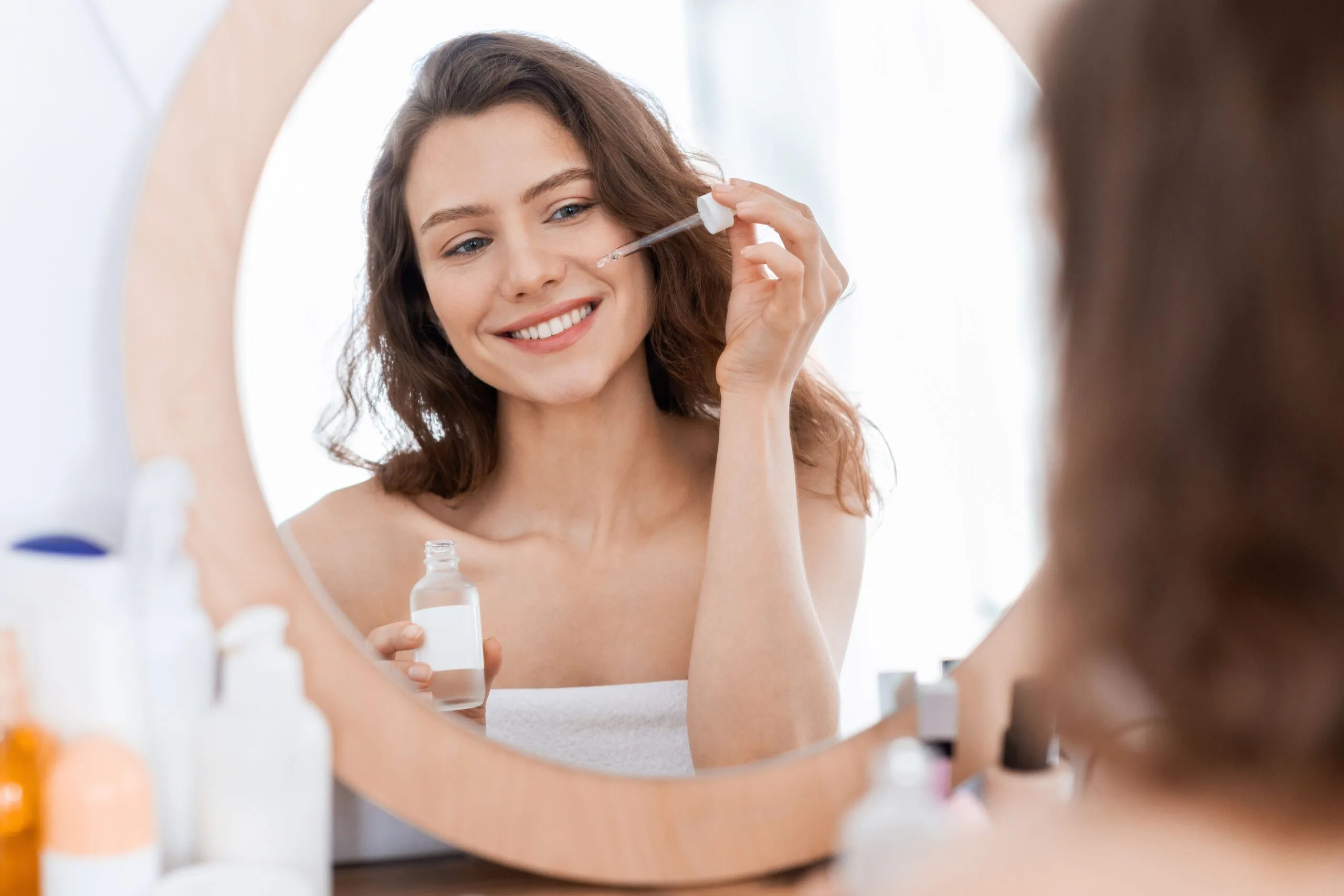

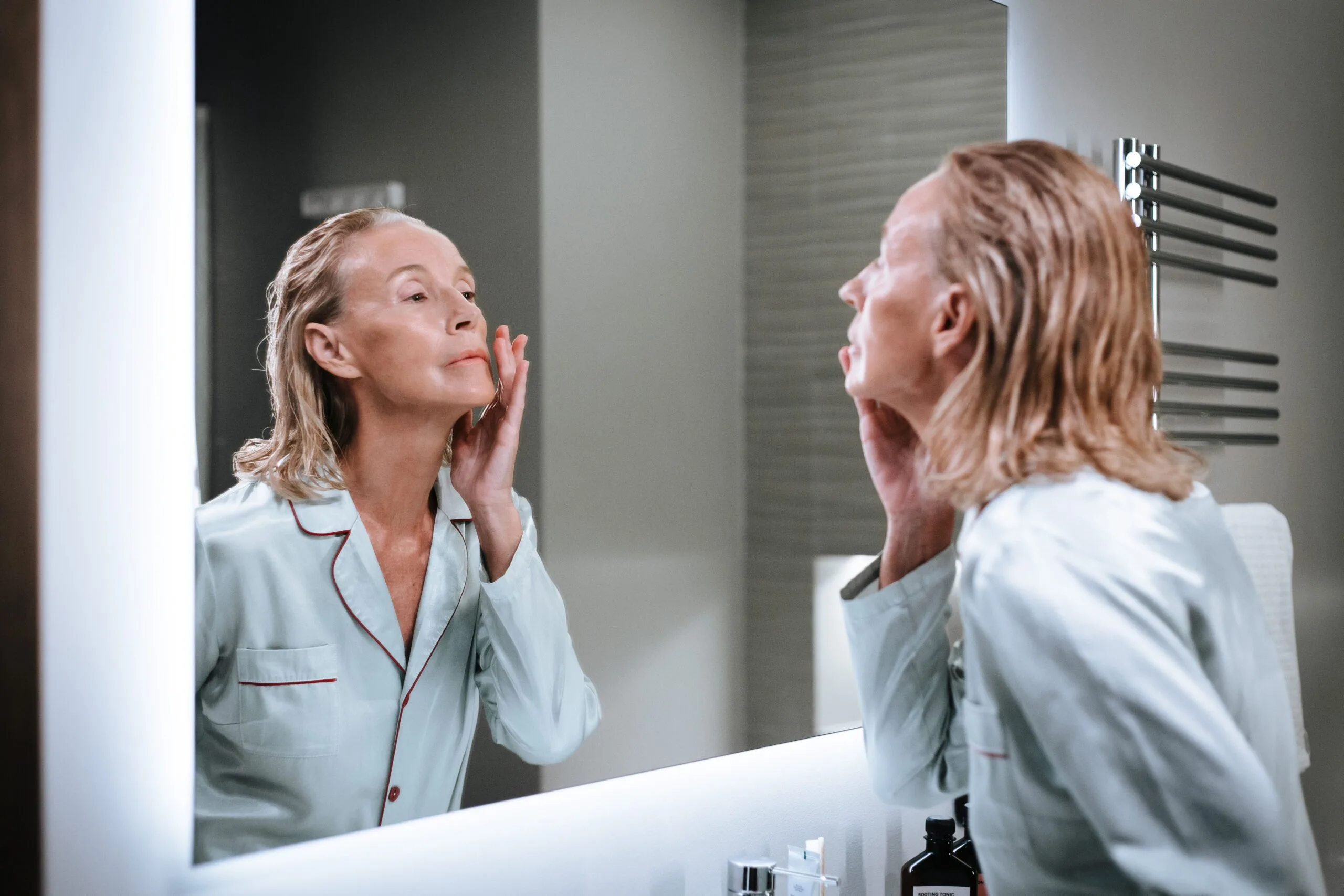
She only picked up the magnifying mirror to find one stray eyebrow hair. Instead, the extra closeness revealed everything the bathroom mirror had politely blurred: a faint brown patch near her cheek, and a few uneven areas around her mouth. Tiny changes that had arrived so gradually she hadn’t noticed them happening. She didn’t immediately reach for concealer. She just stood there, tweezers still in her hand, trying to remember when she had first noticed that discolored patch.
That was the strange thing about pigmentation. The evidence gathers quietly. A mark that used to disappear after summer doesn’t quite disappear anymore. Your once familiar face gradually acquires details that weren’t part of the picture before.
Because the change happens so slowly, the temptation is to respond quickly. Buy the strongest brightening serum or start using something every night because the label promises faster results. Skin in midlife may want hydration before another active and may favor consistency before intensity.
Uneven tone is often the visible result of years of exposure, inflammation, hormonal change, and the natural shifts that come with getting older.
Which raises a better question than “How do I get rid of this?”
Purely Bella raises a different possibility: perhaps brightening mature skin begins with giving the skin what it needs first.

Hyperpigmentation Has a Memory
Sun exposure can leave its imprint, hormonal changes can influence pigmentation, particularly around midlife, and the effects of years of environmental exposure can become more visible as the skin’s natural renewal processes change. Dark spots on mature skin can reflect this accumulated exposure alongside the changes that naturally occur with age. By midlife, several of these influences may arrive at once.
That is one reason a product that seemed perfectly comfortable at 28 can suddenly feel like too much at 48. The barrier can become more vulnerable to dryness and irritation, while hormonal shifts can alter the way skin behaves. The pigmentation that took years to develop is still being judged against the expectation that a new product should fix it in a few days.
Ultraviolet radiation can contribute to pigmentation, while visible light may also play a role in the persistence or worsening of some forms of hyperpigmentation. So brightening begins with protection.
The Problem with Always Going Stronger
A complexion that is already dry, reactive, or easily flushed may not appreciate being confronted with several potent actives at once. Instead of looking clearer, it can become uncomfortable, inflamed, or visibly stressed. For mature skin, the goal is to create better conditions for the skin.
Purely Bella was shaped by Cathi Carrier, a licensed esthetician and certified health coach with 32 years of experience in practice, who spent decades seeing firsthand how changing skin responded to different approaches.
The result is a philosophy that asks what the skin needs now.
How to Care for Mature Skin Without Overcomplicating It
A thoughtful mature skin care routine does not necessarily need a crowded bathroom shelf. For many people, the basics remain surprisingly consistent: gentle cleansing, adequate hydration, ingredients that support the appearance of an even tone, and daily sun protection. The goal is to build a routine that skin can tolerate and that you can realistically maintain.
That is particularly relevant when considering how to care for mature skin. As skin changes with age, maintaining comfort and supporting the barrier can become just as important as addressing visible discoloration.
This is also why skincare for mature skin should not automatically mean stronger skincare. A routine can address several concerns while still respecting the fact that skin may be more prone to dryness or irritation than it once was.
For someone wondering how to reduce the appearance of dark spots, consistency may ultimately be more useful than constantly adding another powerful product. Supporting the skin while addressing uneven tone can create a more sustainable approach than treating every visible mark as something that needs to be attacked.


Brightening Without Losing the Skin Along the Way
One of Purely Bella’s most relevant answers to that question is the Flawless Niacinamide Brightening Moisturizer for Dark Spots & Uneven Tone.
The formula combines 5% niacinamide, 3% tranexamic acid, kojic acid, and glucosamine in a formulation designed to address the appearance of uneven tone.
Niacinamide, for example, has become a familiar name in skincare partly because it can do more than address the appearance of uneven tone. It is also valued for its relationship with the skin barrier and hydration. Rather than treating the complexion as something to strip into submission, it fits naturally into a routine built around maintaining skin comfort.
The inclusion of tranexamic acid, kojic acid, and glucosamine adds another layer to the formulation’s approach to visible discoloration.
Rather than continually increasing the strength of one active, the approach is to bring several complementary ingredients together in a formula designed for consistent use.

The Quieter Antioxidant in the Conversation
Then there is astaxanthin. If vitamin C and retinol have spent years occupying the front row of the skincare conversation, astaxanthin has remained comparatively quiet.
Astaxanthin is a carotenoid antioxidant derived from sources including microalgae, and scientific literature has explored its antioxidant, anti-inflammatory, and photoprotective properties in relation to skin health. Research into astaxanthin’s potential benefits for skin is interesting, although more comprehensive clinical research is still needed.
Every day, skin encounters environmental pressures. Ultraviolet exposure is one of them. Pollution and other forms of environmental stress add to the picture. These processes can contribute to the visible signs we associate with aging and uneven-looking skin.
When Brightening and Hydration Belong in the Same Routine
The company positions Flawless as a treatment and moisturizer in one, with a fragrance-free formula that contains no essential oils or retinol. It also includes ingredients such as glycerin and urea for moisture, alongside antioxidant ingredients including astaxanthin, stable vitamin C, green tea extract, and tocopherol.
Purely Bella reports an eight-week consumer study in which 97% of participants saw a brighter complexion, 95% felt more hydrated, and 92% saw smoother skin after twice-daily use. These are brand-reported, self-assessed consumer results, so they are best viewed as encouraging product-specific findings.
Good skincare doesn’t need exaggerated promises to be interesting.
The Part That Doesn’t Come in a Jar
Sunscreen may be the least exciting part of a skincare routine, but it is one of the most important. The company recommends broad-spectrum SPF 30 or higher every morning alongside Flawless.
For some people prone to pigmentation, especially those with melasma or skin of color, protection from visible light can matter too; research has found that tinted sunscreens containing iron oxides can provide an additional layer of visible-light protection.
In other words, brightening is not about putting one extraordinary product on the bathroom counter and expecting it to do everything.

The Goal Was Never Perfect Skin
Skin has lived. It has stretched, healed, flushed, tanned, broken out, recovered, aged, and changed. It has carried us through pregnancies, holidays, difficult seasons, ordinary seasons, sleepless nights, long workdays, and years we barely remember.
The brown patch on the cheek is not necessarily a failure. The goal can be simpler: skin that looks cared for, feels comfortable, and doesn’t let one patch of discoloration dominate the face.
The brand story doesn’t begin with the promise of turning back time. It begins with decades spent in treatment rooms, listening to women talk about their skin and learning that what worked once doesn’t always work forever.
The brand’s philosophy of aging beautifully feels less like a slogan in that context and more like a conclusion reached through experience. There is something even more meaningful in knowing that the brand extends its philosophy of care beyond skincare: the company says a portion of every sale is donated to the Connecticut Cancer Foundation in honor of the founder’s father-in-law, who lost his battle with cancer.
So perhaps the next time morning light catches that familiar patch of pigment, the response should be curiosity.
What would happen if, instead of fighting your skin, you listened to it?
What if brightening mature skin meant restoring balance rather than demanding perfection?
Sometimes we simply need to give the skin a little more reason to reflect its natural radiance.