

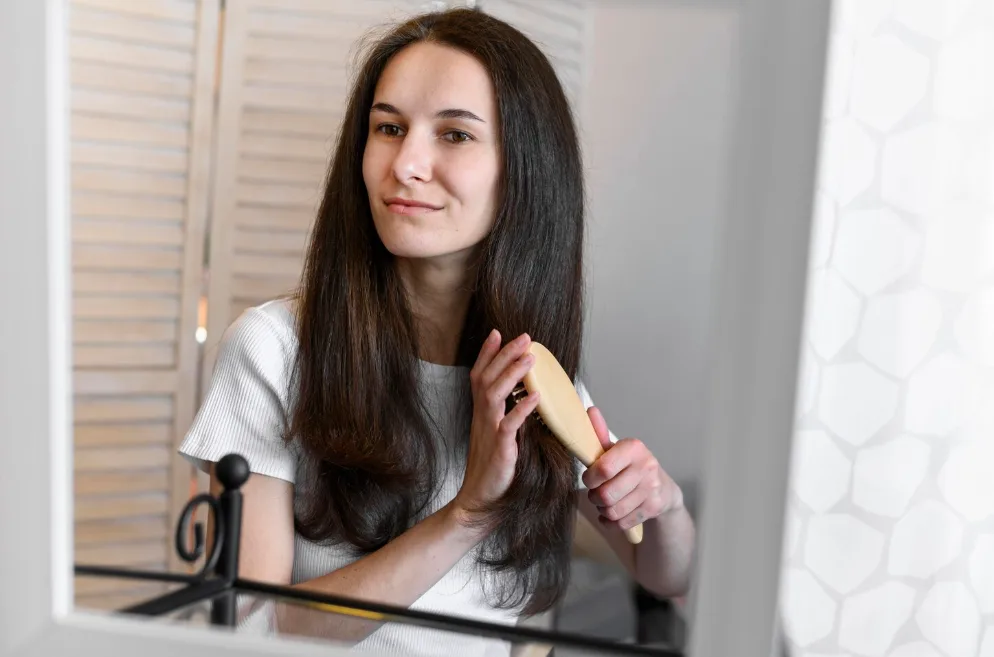
The stylist notices it before the client says anything. It happens when she lifts her hair off her neck and pauses, looking at the back of her head in the mirror. Then she does it again, this time pulling the hair forward over one shoulder. Her fingers separate the strands near her part. She tilts her head toward the light.
“Has it always been like that?” The question sounds casual, but it isn’t.
The stylist has heard versions of it before. A wider part. A smaller ponytail. More scalp showing at the crown. Hair that seems to disappear when it’s tucked behind the ears. Little observations that have accumulated quietly until one day they become impossible not to notice.
The client doesn’t necessarily want to talk about aging, hormones, stress or everything else that may have changed along the way. She may simply want to know whether there is something she can do about what she sees.
So, the stylist doesn’t rush to answer. She watches how the client handles her own hair. That tells her more than the question does. A woman may begin checking her crown in shop windows. She may take fewer photographs from certain angles. She may stop wearing the hairstyle she loved because it no longer falls the way she remembers. Eventually, she sits in a salon chair and says the words that have been waiting there for months: “I just don’t feel like myself.”

When a Familiar Head of Hair Starts to Feel Unfamiliar
Hair changes throughout life. Hormonal shifts, pregnancy, aging, stress, genetics and everyday environmental factors can all influence how hair looks and behaves. Not every change requires intervention, and not every client wants one.
A good hair professional understands the difference between trying to fight the body and finding a way to work with what is there.
Instead of treating fine or thinning hair as a problem that needs to be hidden, the conversation can become more constructive: What would make this person feel comfortable? What techniques are appropriate for the density and length she has now? Those questions require education.
Extend USA was founded by Richard and Cristine Millstein. It has developed its approach around resin bonding, custom color blending and placement techniques designed for areas such as the crown, top of the head and bangs. According to the company, its system can be used on hair as short as one inch, expanding the possibilities for clients who may have previously been told that extensions were not suitable for them.
The Difference Between Adding Hair and Understanding Hair
The most meaningful changes happen when a stylist understands why a client wants something different in the first place. Maybe she wants to wear her hair down again or she wants to stop thinking about the crown when she walks outside. Maybe she has spent years choosing styles according to what will disguise areas she feels self-conscious about.
This is where education becomes part of a more holistic approach to beauty. A stylist who understands different extension methods, placement, weight, color and hair characteristics is better positioned to have an informed conversation rather than automatically reaching for the same technique with every client.

Extend USA’s professional online hair extension course is designed around precisely that kind of skill development. The program is taught by Richard Millstein, who brings more than four decades of experience in the salon and education space and who developed the company’s resin bonding method. The course includes lessons in first-row placement, custom color blending, cutting and styling, followed by a live Zoom certification demonstration with direct feedback.
There is something reassuring about learning from someone who has spent years actually working with hair rather than studying it from a distance. The course is also structured for both newer and experienced stylists, allowing professionals to learn at their own pace and revisit the material through lifetime access.
Where Beauty Becomes a Craft Again
There is satisfaction in finally understanding a technique. It is the same feeling a cook gets when a sauce that once kept breaking suddenly makes sense, or a photographer experiences when composition begins to feel instinctive.
Extend USA’s course goes beyond application alone. The curriculum includes custom color blending, cutting and styling, while the included kit provides European hair, practice hair, a mannequin and stand, a color ring and other materials needed for training. Business guidance, including pricing frameworks, consultation forms and in-salon marketing support, is also part of the program.
A stylist isn’t only learning how to attach hair. They are learning how to think through a complete client experience.
The Art of Making Something Look Like It Was Always There
The goal isn’t necessarily for someone to walk into a room and think, “She has extensions.”
It may be for them to think, “Her hair looks beautiful.”
Extend USA places particular emphasis on custom color blending, teaching stylists to combine multiple colors into a single extension so that the result can more closely reflect the natural variations found in real hair. The course also teaches placement in areas including the bangs, crown and top of the head, areas that can be difficult to address with more conventional approaches.
Hair has structure. It has movement, direction, density and texture. The stylist is working within that existing architecture rather than simply adding something on top of it.

Learning a Method Is Also Learning How To Listen
The strongest beauty professionals learn to ask before they advise. They notice when a client says, “I don’t know, I just don’t feel like myself anymore,” and understand that sometimes the answer is a subtle adjustment that gives someone back a hairstyle she stopped wearing years ago.
Extend USA’s online course is built to combine technical instruction with direct support. Alongside the self-paced modules, the program includes live Zoom check-ins and a one-on-one certification demonstration with Richard Millstein. The company also states that continued support is available after certification.
For professionals, that ongoing relationship may be as valuable as the initial lesson.
The Mirror is Not the Enemy
The woman looking into the mirror today is not supposed to be the woman she was ten, twenty or thirty years ago. She has lived. Her hair has changed because she has changed. There is nothing inherently wrong with wanting to work with those changes, just as there is nothing wrong with leaving them alone.
The more interesting question is whether beauty services can help someone feel more at home with the person she is now.

That is where thoughtful extension work has the potential to become something more than a cosmetic service. For the stylist, it can be an opportunity to deepen a craft. For the client, it can be a chance to rediscover a style she thought she had left behind. It can be a reminder for both that confidence doesn’t always arrive through a dramatic reinvention.
For hair professionals interested in expanding the way they work with fine, short or lower-density hair, Extend USA’s Professional Online Hair Extension Course offers a structured path into its resin bonding system, including technical education, practice materials, custom color instruction, live certification and business support.
The deeper lesson is about what happens when expertise meets empathy.