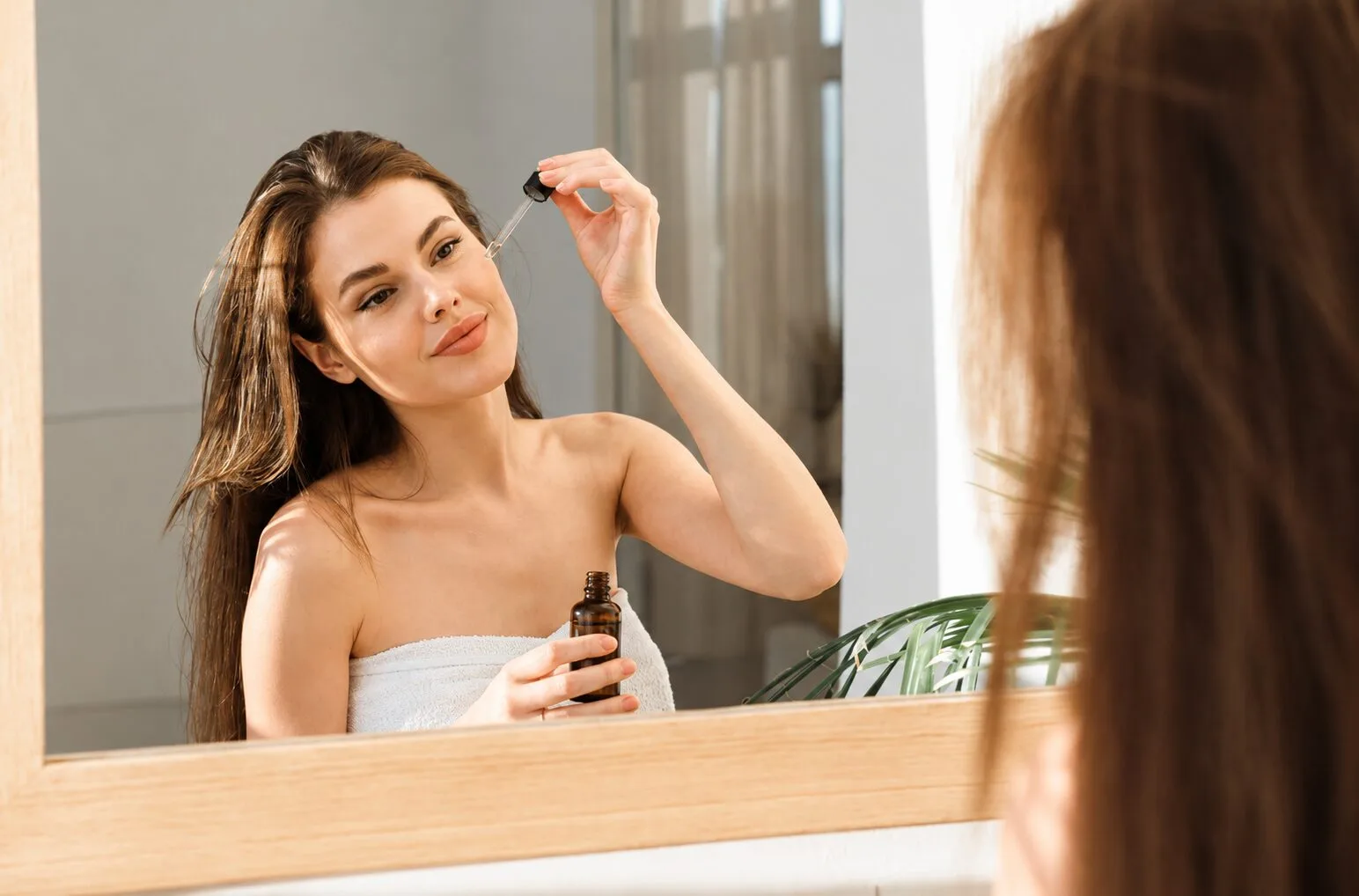


There is a moment many of us know all too well, as much as we’d like to say we don’t. You wake up on the morning of something important. Maybe today is the day of a job interview, or perhaps you need to stand up in front of a hall full of people to do a presentation you’ve spent weeks preparing for, maybe that special first date has finally arrived, and maybe, just maybe this is the day you woke up ready to show up as the best possible version of yourself. Then you catch your reflection in the mirror. Your body has other ideas for the day.
A blemish is staring at you in defiance, right from the middle of your forehead. It literally popped up overnight.
Logically you know it is small. You know no one else is likely to care as much as you do. To you, that tiny spot feels somehow enormous. It becomes the first thing you see and, for a moment, the only thing you can think about.
In a culture that constantly tells us confidence comes from within, yet we rarely acknowledge an uncomfortable truth: confidence is influenced by countless small external factors too.
- The way our clothes fit.
- The amount of sleep we got.
- The conversation we had before walking into a room.
- And yes, sometimes, the condition of our skin.
The wellness industry has spent years encouraging people to embrace authenticity and self-acceptance. Certainly, those are worthy goals, but perhaps true wellness is not about pretending appearance never matters. Perhaps it is about creating practical solutions that help people focus on what truly matters when life presents an important moment.
That change in thinking may explain why a new generation of science-driven skincare brands is gaining attention, and why consumers are increasingly looking for more than exaggerated marketing claims in the search for products that solve real-world problems.

The Hidden Emotional Weight of Breakouts
Acne and blemishes are often discussed as cosmetic concerns, but, if you have ever been on the wrong end of this experience, you will understand that the emotional impact is considerable, and can affect how you see yourself in the eyes of the world.
Multiple studies have linked acne and visible skin concerns with reduced self-confidence, increased social anxiety, and lower quality-of-life measures. While a single breakout may not seem significant from a medical perspective, the psychological experience can be surprisingly powerful.
Think about how many important moments happen face-to-face.
- Job interviews
- Presentations
- Networking events
- Weddings
- Dates
- Family celebrations
- Professional headshots
- Social gatherings
In these moments, people want to focus on their ideas, talents, and relationships, not on figuring out how to hide a breakout.
Traditional solutions often create a new problem. Many people reach for concealer, only to discover that heavy makeup can draw attention to texture or further irritate the affected area. Others use conventional blemish patches that can be highly visible, especially in professional or social settings.
The result is a frustrating compromise: treating the blemish often means acknowledging you have the blemish and then putting it on display for all to see.
For years, consumers accepted this tradeoff because there seemed to be no alternative.
Why Consumers Are Demanding Smarter Skincare
The modern wellness consumer is much more knowledgeable than before. People read ingredient labels, research active compounds, and compare clinical evidence. They understand that there is a vast difference between marketing language and scientific validation.
This evolution is changing expectations across the beauty and wellness industries.
Today’s consumers want products that are:
- Backed by credible science
- Easy to use in real life
- Compatible with modern lifestyles
- Designed around genuine consumer needs
- Transparent about what they can and cannot do
Consumers are no longer looking for miracle claims. They are looking for intelligent solutions.
The most innovative products are not necessarily the ones promising dramatic transformations. Often, they are the ones solving small but persistent frustrations that people encounter every day.
One of those frustrations has been remarkably overlooked: how do you treat a blemish without drawing attention to it?
The Rise of Functional Beauty
A fascinating transition is occurring at the intersection of beauty and wellness. For years, the industry focused heavily on aspiration. Products were marketed around idealized outcomes and carefully curated aesthetics. Packaging became a major selling point. Social media accelerated visual storytelling.
A growing number of consumers are asking a different question, “Does it actually work?”
This movement toward functional beauty places performance ahead of appearance. It values efficacy over hype and practicality over trends.
Brands that embrace this philosophy tend to share several characteristics:
- Scientific rigor
- Ingredient transparency
- Evidence-based formulation
- Problem-solving innovation
- Consumer-first design
Among the emerging companies embracing this approach is DPhiant Corporation, a science-led skincare brand founded by Dr. Bicheng Wu.
Science With Purpose
What makes certain founders stand out in the wellness space is not their ability to market products, but their willingness to challenge industry assumptions.
Dr. Bicheng Wu’s background is unusual even by beauty industry standards.
With a PhD in Food Science from UMass Amherst, an MBA from Columbia Business School, experience in Research and Development at Estée Lauder and Ingredion, and work as an adjunct professor and product developer, her career has spanned multiple scientific disciplines.
She built a brand around a question, “What if skincare products were designed to solve real problems first?”
Innovation often comes from challenging assumptions.
Rethinking the Blemish Patch
DPhiant’s first product, CLEAR SHOT Invisible Liquid Blemish Patch, launched in May 2026 with a simple but surprisingly disruptive idea:
What if a blemish patch didn’t look like a patch?

Traditional hydrocolloid patches have become popular because they create a protective barrier over blemishes. However, they also have limitations:
- They are visible on the skin
- They come in predetermined shapes and sizes
- They may not blend seamlessly across all skin tones
- They can interfere with makeup application
CLEAR SHOT approaches the problem differently.
Using proprietary DermVeil Technology, the formula applies like a cream and transforms into a thin, breathable film directly on the skin. The result is a protective layer that becomes virtually invisible once applied.
This seemingly simple innovation addresses a practical challenge many consumers have quietly accepted for years. Instead of choosing between treatment and appearance, users can potentially have both.
The Science Behind the Innovation
Innovation in skincare is most meaningful when it combines novel delivery systems with proven ingredients.
CLEAR SHOT incorporates 2% salicylic acid, one of the most widely recognized and researched ingredients for blemish-prone skin.
Salicylic acid is known for its ability to:
- Help remove dead skin cells
- Support pore clarity
- Improve the appearance of congestion
- Reduce the appearance of redness and swelling over time
Rather than relying on trendy ingredients with limited evidence, the formulation centers on established science.
Equally notable is what the product does not do:
- It does not promise overnight miracles
- It does not claim to eliminate every breakout instantly
- It does not rely on exaggerated marketing language
Instead, it focuses on delivering practical benefits grounded in ingredient science and thoughtful design.
That approach aligns closely with what today’s wellness consumers increasingly value: honesty.

Confidence Is a Wellness Issue
The conversation around skin health often overlooks a crucial point. Confidence itself is part of wellness.
Not because flawless skin defines self-worth, and not because appearance should determine confidence, but because confidence affects how people move through the world.
When someone feels comfortable in their skin, they may:
- Speak up more freely
- Pursue opportunities more confidently
- Engage socially with less hesitation
- Focus on meaningful experiences instead of perceived flaws
A blemish should never determine whether someone shares an idea, attends an event, introduces themselves to someone new, or steps into an important opportunity.
These seemingly minor insecurities can sometimes influence behavior in subtle ways. Products that reduce those distractions are cosmetic, but more importantly, they can support emotional well-being by helping people keep their attention where it belongs.
The Bigger Story Behind DPhiant
Perhaps the most compelling aspect of DPhiant is that its story extends beyond skincare. The company’s philosophy emerged from a broader belief about resilience.
Founder Dr. Bicheng Wu has spoken openly about confronting messages that suggested girls were inferior, that scientists belonged only in laboratories, that parenthood limited ambition, and that leadership required a particular personality type.
Rather than accepting those narratives, she challenged them. That spirit is embedded throughout the brand.
The first product happens to be a blemish solution. The underlying mission is larger: helping people move through the world without allowing small obstacles to become larger limitations.
The blemish itself, in this sense, is almost symbolic. It is a small thing, a temporary thing, and a thing that can feel much bigger than it really is.
The Future of Wellness May Be More Practical Than Inspirational
The wellness industry often focuses on transformation, but perhaps it should focus on something more attainable and meaningful. It is not always about becoming someone new, it is about removing unnecessary friction from daily life.
The products that shape the future may not be the boldest or trendiest on the shelf; they may be the ones that quietly solve problems people have tolerated for years.
- They may be built by scientists rather than marketers
- They may prioritize function over spectacle
They may recognize the simple truths:
- People already have enough challenges to overcome
- A blemish should not be one of them
As consumers continue demanding transparency, evidence, and real-world performance, brands that embrace science with purpose are likely to define the next era of wellness innovation.
The next time an unexpected blemish appears before an important day, the goal may not be perfection. It may simply be having one less thing competing for your attention.