
The first thing to disappear is usually the detail you liked most. The little honeycomb pressed into the top of the soap becomes less defined after a few weeks at the sink. The oats that once caught against your fingertips have softened away. The corners round off. The bar gets thinner, lighter, easier to pick up with one hand.
You reach for it each morning, lather it between your palms, rinse, and set it back on the dish. Then one day, you realize that the thing that looked almost too pretty to use has become something else entirely: something familiar.
It isn’t precious because you leave it untouched. It becomes precious because you use it.
When you know something has been crafted by someone’s hands, you give it a different kind of attention. You notice its shape, scent and the way its colors came from plants or how its surface changes as the weeks pass. An everyday act that usually disappears into the background suddenly has a little more texture to it. At the sink, that can be enough.

Meet the Woman Behind the Bars
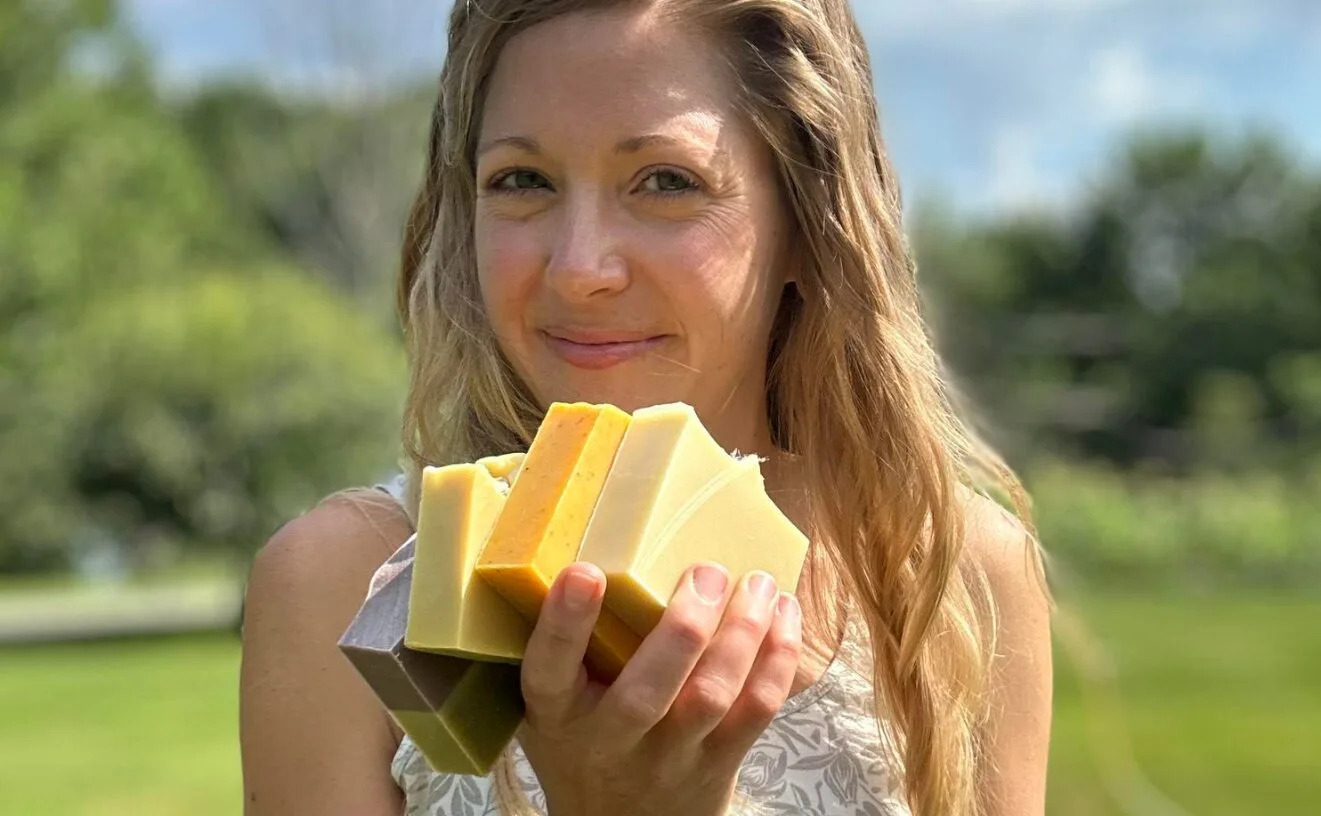
Beauty from Ash Soap was founded in 2025 by Ashley Howe. She is a lifelong Vermonter who began her soapmaking journey as a hobby nearly a decade earlier. Over time, this small hobby turned into something far more meaningful.
Her background brings together two worlds that rarely appear side by side: nutrition and beekeeping. Before she turned soapmaking into her business, she worked as a nutritionist and became a co-owner of a family-operated apiary.
Rather than treating soap as purely functional, she wanted to bring the same appreciation for balance and quality that had shaped her earlier work into something people could use every day. The result is a collection of botanical soaps and skincare products built around natural oils, botanicals, essential oils, and plant-derived colors.
The phrase “Beauty from Ash” pulls on the traditional history of soapmaking. Traditionally, ash and fats were used to make soap. It also carries biblical meaning, inspired by Isaiah 61:3 and the idea of beauty emerging from the ashes.
In 2024, personal loss and a career change left Ashley facing a very different future. Soapmaking, once a hobby she had kept for nearly a decade, began to take on a new meaning.
From Plants to Pretty Bars
At Beauty from Ash Soap, the soaps are made in small batches, and the attention extends beyond just the formula and focuses on the visual details as well. From the design that is pressed into the top of the bars to the way that orders are packed, every step is carried out with intention to turn something as ordinary as cleaning into something that feels truly considered.
This approach mirrors Ashley’s connection to whole-food nutrition. The soaps utilize essential oils rather than being scented with traditional fragrance blends and are naturally colored with plants.
Of course, natural does not automatically mean better for every skin type. Skin is a very personal thing, and even a botanical blend may irritate specific individuals’ skin. However, for those who enjoy understanding the ingredients that make their way into their personal-care routine, an ingredient list they can understand is a good place to start.
Oatmeal is one of those familiar ingredients that has remained a staple in skincare for generations. Research has explored its role in formulations designed for dry skin. A 2016 randomized controlled study published in the Journal of Drugs in Dermatology suggests using a colloidal lotion may improve measures including skin dryness, moisturization, and barrier function in those who are navigating dry skin. The research looks at a very specific oatmeal-based lotion, not a handmade soap, so it cannot be used as proof that every product that contains oatmeal will produce the same results.
It does, however, offer insight as to why oatmeal continues to be used in gentle-feeling skin care formulations.
Which Soap Mood Are You In?
The collection includes two soaps that approach the same simple ritual from very different sensory directions.
The Oatmeal, Milk, and Honey Soap is a comforting combination of oats, coconut milk, honey, and a light hint of orange essential oil. The ingredient list also brings together olive oil, coconut oil, shea butter, and castor oil.
The goal wasn’t to focus on offering an overpowering scent; instead, the combination of ingredients leans more towards something that feels familiar and comforting. This product features a honeycomb detail on the top and is finished with real oats, which give the bar a handcrafted feel.


- Oatmeal, Milk, and Honey Soap: Features oats, coconut milk, honey, olive oil, coconut oil, shea butter, and castor oil.
- Scent: Lightly scented with orange essential oil.
- Look: Finished with a honeycomb imprint and real oats.
- Best suited to: Those drawn to comforting, simple botanical ingredients and a softer sensory experience.
The Garden Mint Soap takes a different direction. This is a sea salt brine bar, which means that the salt has been incorporated into the lye solution during the soap-making process. This can contribute to a harder bar with a smooth and silky lather. The ingredient list features coconut, olive, shea butter, castor, and rice bran oils that have been combined with sea salt, spirulina, honey, poppy seeds, spearmint, Himalayan pink salt, and a spearmint-and-eucalyptus essential oil blend.
- Garden Mint Soap: A sea salt brine bar made with several plant oils and butters.
- Scent: An essential oil blend of spearmint and eucalyptus.
- Look: Includes pink salt, poppy seeds, and spearmint leaves.
- Experience: Designed around a fresh, invigorating feel that can make a morning shower feel more like a small reset.
One feels like the soap you’d reach for when you want the day to slow down. The other feels like the one you’d choose when you want to wake it up.

The Details We Use Up
Perhaps the thing that makes a handmade bar worth noticing in the first place is that its beauty changes through use.
The honeycomb becomes less distinct. The oats disappear. The edges soften and the bar gradually gives itself over to the hands that reach for it every morning. Eventually, there is nothing left to admire on the surface because the bar has done exactly what it was made to do.
There is something meaningful in that. In a culture that often encourages us to save the beautiful things for later, a bar of soap offers a different lesson. Beauty does not have to be preserved to have value. Sometimes it becomes more meaningful precisely because it is part of the everyday.

That idea sits naturally at the heart of Beauty from Ash Soap. Ashley Howe’s story is, in its own way, about making something tangible from a period of uncertainty and giving it a place in ordinary life. Her soaps are small objects, but they carry the marks of the process behind them: the ingredients selected, the batches made, the details pressed into each bar, and the hands that shaped them.
Then someone takes one home and uses it. The next morning, it is sitting beside the sink again. The honeycomb may be a little softer than it was yesterday. The bar may be a little smaller. Eventually, those details will disappear altogether.
The things we use every day do not need to be extravagant to become meaningful. Sometimes, they only need to give us a reason to notice the moment we’re already in.