

Some mornings begin with obvious reasons for being tired: a late night, an early alarm, or eight hours spent replying to emails and answering messages while wondering where the day has gone.
Then, there’s the kind of tiredness that makes someone look at their coffee and start to wonder if another cup will magically solve everything.
For many years, the wellness conversation has focused on the things that people can either see or feel. Sleep, exercise, food, skin, and stress. There has been a strong focus on finding the perfect morning routine that can transform a chaotic day into one that feels peaceful.
Beneath those visible routines, cells are carrying out their own continuous work: processing energy, responding to stress, repairing damage and communicating with one another. It is a complex operation taking place quietly while people worry about replying to emails and deciding what they have enough energy to cook for dinner.

Welcome to the Research Rabbit Hole
Curiosity can start with something as simple as wanting to understand why someone suddenly feels different after a workout, developing an interest in aging and recovery, or wondering why certain biological processes change over time.
Researchers are observing molecules, signaling pathways, enzymes, and cellular processes, which are easy to overlook because they cannot be seen happening.
FormulaV Pharmaceuticals is a brand that was founded as a way to offer researchers access to compounds as well as documentation, testing information, and educational material designed to make science much easier to explore. They have a carefully curated selection of research compounds, with products that are sourced and handled in the United States and are provided with batch-specific testing information.
The desk might be covered with papers, notes and browser tabs, while the compound itself sits almost quietly among them. What matters is the information surrounding it: where it came from, how the particular batch was tested, what the research says and, just as importantly, what remains unknown.
Education is also part of the research environment FormulaV Pharmaceuticals has built, alongside access to compounds, testing information and supporting material.
Two Compounds, Two Areas of Scientific Interest
Two products that are featured in the catalog are NAD+ and GHK-Cu. These two compounds focus on two different areas of biological research. NAD+ is a coenzyme found in the body and involved in fundamental cellular processes related to energy metabolism and redox reactions.

Scientific literature has also looked at its potential involvement in other processes such as DNA repair and cellular stress response. This makes it a subject of interest for researchers investigating how cells manage energy and maintain normal biological functions.
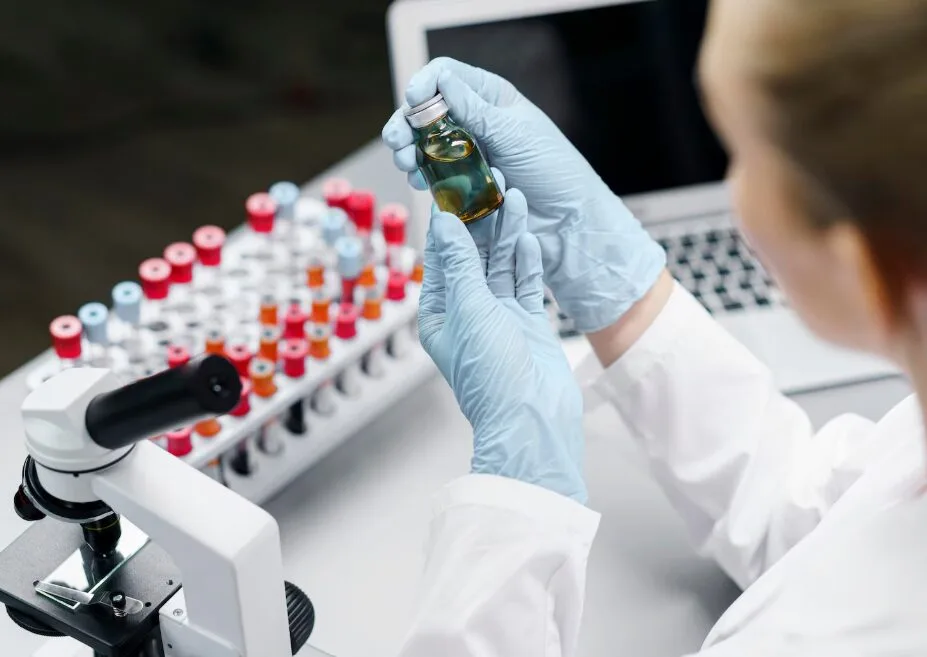
The NAD+ research material is supplied as laboratory research material rather than as a wellness treatment. The NAD+ research vial contains 500 mg of lyophilized powder, with a listed batch purity of 99.58%. The material is accompanied by a batch-specific certificate of analysis, providing information about that particular batch rather than relying only on a general product description. Third-party analysis includes identity confirmation, endotoxin testing, sterility screening, and heavy-metal screening. The material is intended for in vitro and laboratory research only.
There is a distinction between research and treatment. NAD+ has become a very popular topic of conversation in the wellness world; however, important questions remain about how NAD+-related interventions translate into meaningful outcomes in humans. Human studies remain limited compared with the much larger body of preclinical and laboratory research.
GHK-Cu follows a similar research-focused approach, although the compound itself belongs to a different area of biological investigation. The copper-binding tripeptide is supplied as a 100 mg vial of lyophilized blue powder, with a listed batch purity of 99.74%. Its accompanying documentation includes a batch-specific certificate of analysis, LC-MS identity confirmation, endotoxin and sterility screening, and heavy-metal screening. Like the NAD+ material, it is designated for in vitro and laboratory research rather than use as a wellness treatment.
In research, the documentation matters because the vial is only one part of what is being examined. Batch-specific records provide a way to see how that particular material was characterized and what testing was performed. That distinction matters when the purpose is investigation rather than assumption.
Just because a compound is being studied or observed for a particular biological mechanism doesn’t mean the final result is proven to offer the same effect in humans. Good research takes time and often requires a little patience.

Reading the Research More Closely
The most useful questions in cellular research are not always the ones that produce the most immediate answers. A compound can be associated with a particular biological process, but understanding what that association means requires looking closely at how the evidence was gathered.
With NAD+, for example, research has examined its involvement in processes including energy metabolism and DNA repair, as well as questions surrounding aging and changes in cellular function. The interest lies not simply in NAD+ itself, but in what researchers can learn from changes in its levels and activity.
GHK-Cu raises a different set of questions. Research has examined the copper-binding tripeptide in areas including tissue repair, collagen activity, and cellular signaling. Much of that work has taken place in laboratory settings or animal models, making the distinction between an observed biological effect and an established human outcome particularly important.
That is where the details of a study begin to matter. What has been studied? Was the research conducted in cells, animals, or humans? What was actually measured? How closely does the experimental setting resemble the conditions being discussed outside the laboratory? And what does the available evidence still leave unanswered?

Those questions can make scientific research feel slower than the wellness conversation around it. A headline can turn a complicated biological mechanism into a simple phrase, while the underlying research may contain several layers of qualification. Reading beyond the headline means paying attention to the model used, the evidence collected, and the limits of what can reasonably be concluded.
For researchers, that uncertainty is not an inconvenient footnote. It is part of the reason the work continues. NAD+ and GHK-Cu remain subjects of investigation precisely because there are questions left to explore.
That brings the conversation back to the coffee sitting on the desk. It can still be tempting to look for one simple answer to a complicated feeling. Research offers something different: not an instant solution, but a closer look at what is happening beneath the surface.