

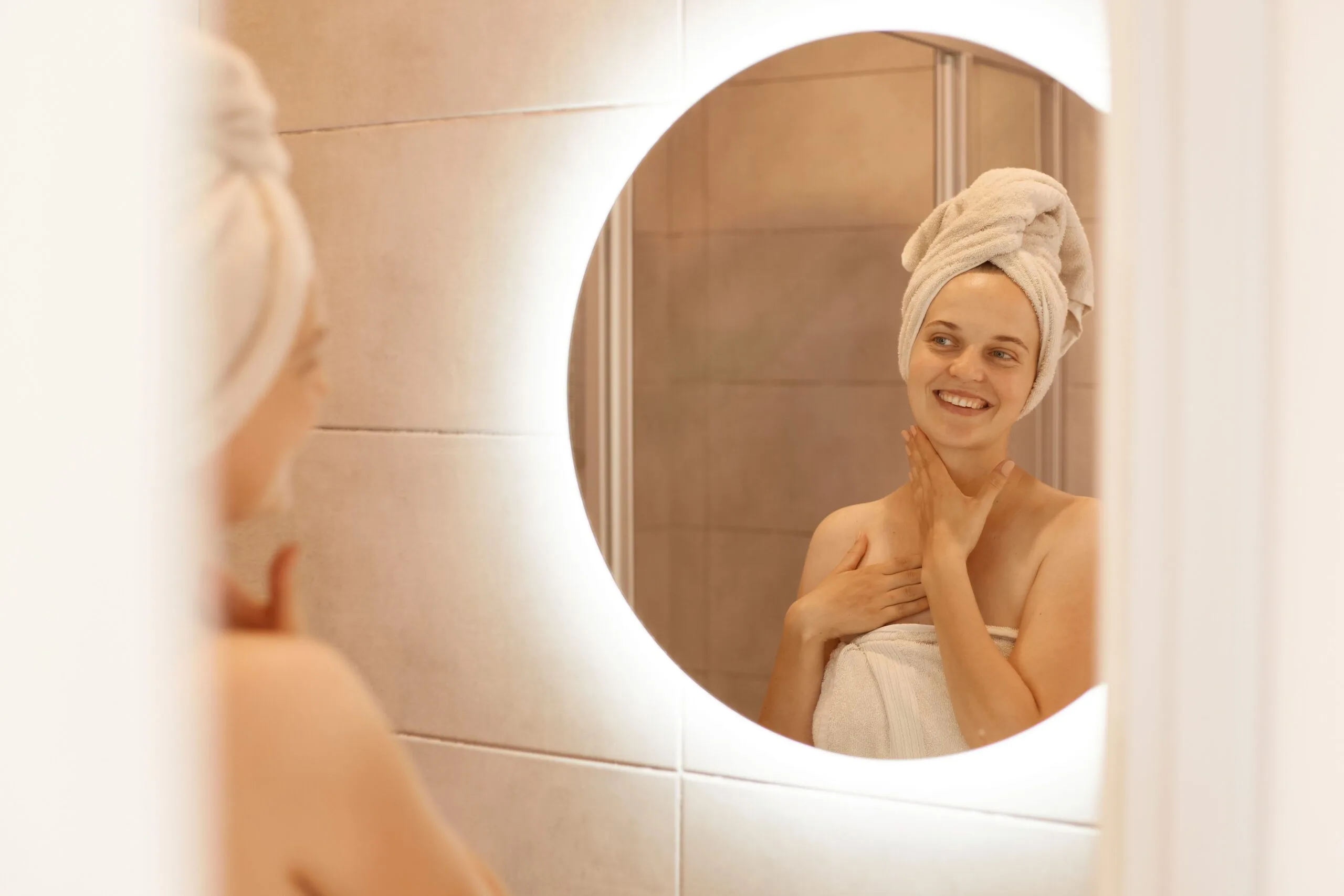
She had put her phone on the bathroom counter deliberately, thinking that washing her face would be the one part of the evening when she wouldn’t need to look at it. The phone kept buzzing regardless. The water was warm, the bathroom was quiet, and a few drops of cleanser were already worked into her palms. The screen lit up again. She glanced at it. A message and two reminders flashed across the screen. Something that could probably wait until morning, but in the moment, it doesn’t always feel that way.
The cleanser was rinsed away, the towel reached for, and the evening carried on.
Her evening skincare routine was supposed to be a small act of self-care. Instead, it had become another thing to complete properly, somewhere between answering messages, making dinner, clearing the kitchen and remembering everything that hadn’t been done yet. What was meant to create a little space in the day for self-care had become another task to complete.

When Wellness Becomes Another Task
Sacred Stems brings that idea into its collection through small-batch botanical products inspired by traditional herbal wisdom and natural living. Based in Colorado, the botanical apothecary makes handmade oils, teas, balms, tinctures, lip balms and bath products designed to fit into ordinary routines.
When a Pause Doesn’t Need a Purpose
Stopping and pausing are not always the same thing.
A 2024 randomized, multi-site study published in Nature Human Behaviour looked at four brief, self-administered mindfulness exercises among 2,239 individuals. The research findings suggest that the four exercises were associated with lower short-term self-reported stress than an active control.
A routine can begin with something almost too small to count: a few drops of oil, a warm cup of tea, the scent of an herb or the feel of warm water against the hands.
Give the Routine Somewhere to Land
One reason small routines disappear is that they are often left floating somewhere in the day. “Take a few minutes for myself” sounds worthwhile, but it is vague enough to be postponed when dinner runs late or another message comes through.
A more practical approach is to attach the routine to something that already happens. Tea can follow the last kitchen clean-up of the evening. A face oil can come after brushing the teeth. A bath can become the point at which the phone is left charging in another room.
Behavioral research on habit formation suggests that repeating an action in a consistent context helps strengthen the association between the cue and the behavior. In other words, the existing routine can do some of the remembering.
That also removes some of the pressure to be perfectly motivated. The aim is not to create another item on a long daily checklist, but to give a small action a familiar place to occur.
And when the routine is missed, it can simply resume the next time the cue appears. There is no need to turn one skipped evening into another thing to catch up on.

Make It Easier to Keep
A routine is more likely to survive ordinary life when it asks very little of it. Five products, a precise order and a twenty-minute window can make even a pleasant ritual feel like another commitment. A routine built around one familiar action has fewer points at which it can fall apart.
It can help to decide what the routine is actually for before adding anything to it. If the intention is to create a quieter transition into the evening, the useful part might be the cup of tea rather than everything that happens around it. If skincare is the pause, there may be no need to turn it into a seven-step process. If a bath is the cue that the day is winding down, the ritual does not need to become an elaborate production.
There is also a practical difference between a routine that restores attention and one that creates more decisions. The latter asks what to use, when to use it, whether it was done correctly and what should be added next. The former leaves enough room for the person doing it to actually notice the experience.
Real evenings are rarely predictable. Some nights allow twenty quiet minutes. Others offer five. A routine that can shrink without disappearing altogether has a better chance of becoming part of everyday life.
Taking Time
The Sacred Bloom Botanical Face Oil brings blue lotus, butterfly pea and lavender into the routine. Rather than turning skincare into another multi-step project, its appeal lies partly in the simplicity of the format: a few drops into the hands, a moment to notice the scent and texture, then the oil worked slowly into the skin.
The process itself becomes part of the routine. The oil is warmed between the hands, the scent has a moment to register, and the massage takes slightly longer than it might when skincare is treated as another box to tick.

And then there are days when wellness has very little to do with how the skin looks. Sometimes the most appealing ritual is simply a warm shower, a blanket and an earlier-than-usual bedtime. The Mountain Air Chest Balm fits naturally into that kind of routine, bringing eucalyptus, lavender, peppermint and mullein together in a rich botanical balm designed to be massaged onto the chest. Its herbal aroma adds another sensory layer to the experience, particularly when the evening has already been long.
Small Routines That Make Room for the Ordinary Moments
Beyond skincare and balms, that same sensibility appears in the collection through herbal teas, bath products and crystals. A cup of tea can mark the point at which the day is finished. Herbs, flowers and salts can change the character of an ordinary bath. A crystal on a windowsill can become a small visual cue to stop and notice the room.

Wellness shouldn’t demand a dramatic reset, an early 5.00 a.m. alarm, or the promise of becoming a different person in two weeks. Sometimes the routine really is one cup of tea, a few drops of oil or a bath at the end of a long day.
For some, that might mean reconnecting with plants and traditional herbal wisdom. For others, it might simply mean taking five quiet minutes before bed.
By the end of the evening, the phone may still be sitting on the bathroom counter. The laundry hasn’t disappeared, dinner still needs cleaning up, and tomorrow’s reminders are still there. The face has been washed, and for a few minutes there was no need to answer anything.
The phone can buzz. The message can wait.