


It appears that none of the well-known tales are totally accurate. The tales from 221 B.C. and 414 A.D. are the two that are most prevalent. The tale of the Chinese farmer who accidentally created Kombucha is one of the earliest origin legends for the beverage. This tale is most likely the most believable of all those that are now circulating. As a result, the Chinese farmer in this story does not finish his tea since he must leave his home for a few days. When he comes back, he discovers that his tea has something unusual growing on top of it. He tries the tea and decides to keep it.

He likes the flavor of it and feels refreshed after drinking it. This is supposedly how the first Kombucha was created. When we examine this scenario thoroughly, it really makes sense and looks quite likely. First, historically speaking, it would return us to the earlier era, before the seventh century, when tea was drunk in a different way. In order to eliminate the bitterness at the time, it was actually sweetened. During that time, honey was frequently employed as a sweetener, and it’s possible that honey is what drew the fruit fly. a fruit fly that contains the acetobacter bacteria, which are found on the legs of the fruit fly. Hence, the first Kombucha culture would be born as a result of this specific fruit fly dropping into the sweetened tea. Russia is the source of yet another tale or myth. In this one, a monk with healing abilities was called to aid a sick emperor. The monk places an ant in the emperor’s tea after promising to use it to cure his illness. He then gives the emperor the advice to wait for the jellyfish to develop and turn the tea into a therapeutic elixir before consuming it. The emperor was healed as a result of taking the monk’s advice. Finally, a fable with a similar ring, this time from Tibet: “According to a tradition from Tibet, a monk slept off and a bacteria-carrying bug landed in his brand-new cup of tea. A civilization was able to develop because the teapot was forgotten.
The monk shared this tea with others after learning about its amazing qualities. We may deduce that there is a pattern here involving tea and an insect, most likely a fruit fly. In other words, the development of Scoby and subsequently the first Kombucha was rather a natural process. Let’s return to the incident from 221 B.C. Qin Shi Huang, a Chinese emperor (personal name Ying Zheng), he helped establish the Qin dynasty and was the first emperor to unite China. Also, he had an obsession with discovering the fabled “elixir of life.” He was looking for a miraculous elixir that would make him eternal. The Kombucha that is intended to be this “elixir of life” is now expected to be discussed at this point in its history. The term “Tea of Immortality” may not actually relate to Kombucha after all when you consider that medicinal mushrooms like Reishi, Chaga, or Birch Polypores are also traditionally prepared in the form of a “tea”.
Let’s now examine the second well-known tale, which purports to provide the origin of the term Kombucha. In this tale, a Korean physician named Kombu from the Silla kingdom travels to Japan in the year 414 A.D. and heals the Japanese monarch Ingyin. Also, a source of information is cited for this information (as well as for the 221 B.C. story). The “Illustrierte Geschichte der Medizine” encyclopedia, which was released in Germany in 1980, serves as the source in question. The nine-volume book traces the development of medicine throughout the world. There is only one phrase regarding it in book two. The official beginning of medicine is typically dated to 414 CE, when the Korean physician Kombu from the Kingdom of Sylla traveled to Japan with a mandate to heal the Emperor Inkyo. That’s all, then. Nothing more or less. Since it isn’t specified here, it will always be a mystery as to how and what exactly Dr. Kombu employed to cure the Emperor. Nevertheless, suppose he accomplished this using a fermented tea, which is not described elsewhere, and suppose the emperor gave the fermented tea the name of the doctor in question.
We would then get the first two letters of the name Kombu + Cha. But, why does the word Kombucha not refer to a fermented tea beverage in Japan (instead of a non-fermented beverage made from algae)? Why isn’t this name used in Korea, too? And why is Kombucha not mentioned in known historical accounts after 414 A.D.? The reason can be fairly straightforward. Particularly if Merriam-claim Webster’s that “the earliest known usage of (the term) Kombucha was in 1944” is accurate. And that is probably accurate given that Kombucha has been referred to by a variety of names in various nations all over the world. The Big Book of Kombucha by Hannah Crum mentions some of them. As we advance through the history, we encounter two further Kombucha-related stories. Both stories include soldiers, and Kombucha is purportedly used in both to give the warriors vigor and endurance before combat.
[restrict]The first one takes us to Genghis Khan’s Mongol kingdom, which ruled over this region between the years 1180 and 1227. It was reported that during those years, his valiant troops would sip Kombucha before battle. Once more, it’s only a tale—better still, a myth. There are no historical documents from the era that reference Kombucha. On the other hand, a fermented beverage that was probably drunk at the time exists. Kumis is the name of that beverage (or Kumys).
It is a fermented mare’s milk beverage that has a low alcohol content. The history of this beverage dates back to the fifth century B.C., which is another distinction from the history of Kombucha. Given that Kumis is Mongol in origin, it is exceedingly improbable that those nomadic warrior tribes produced and drank two distinct fermented beverages. In the second tale, Samurai soldiers from Japan are described as consuming Kombucha prior to battle. Speaking about soldiers before conflicts, I just learned a humorous tale from Turkey. Turkish consumers enjoy kombucha quite a bit, and they have for some time. In some regions of that nation, it is customary for males to consume Kombucha before their wedding night in order to “perform” on that important night.
Probiotics and Prebiotics
What distinguishes probiotics from prebiotics? And how do they function as a team? Find out all you need to know to boost your immune system, digestion, and a plethora of other health advantages. See which foods naturally contain probiotics and prebiotics to determine whether you require a supplement. Probiotics are definitely something you’ve heard of, but what about prebiotics?
Even though the names are similar, they each have separate (and complimentary) functions for the health of your stomach. You’ll understand why eating enough of both probiotics and prebiotics is essential if you want to maintain or repair your gut, and why eating enough of these natural food components has benefits beyond digestion.

The beneficial bacteria that live in your gut are known as probiotics. (Your body contains both good and toxic bacteria; a healthy stomach requires a balance.)
You benefit from probiotics in a number of ways: They help with digestion and food breakdown, gut health in general, and immune system function. They also affect your thoughts and emotions. The synthesis and control of hormones like leptin and insulin can be enhanced by gut microbes. Also, it has been shown that they create neurotransmitters important for mood regulation, including serotonin, dopamine, and GABA. Prebiotics provide the healthy bacteria with nourishment. They are made of non-digestible fiber, which may be found in some plant-based meals. Prebiotics and probiotics are both necessary. They cooperate to sustain your microbiome, the billions of microorganisms that live in your body and keep it healthy. It is a partnership with synergy. Without prebiotics as a source of energy, probiotics would go hungry, leaving you vulnerable to a variety of issues including leaky gut, a weakened immune system, and constipation. Also, prebiotics wouldn’t be of much use to your stomach if there were no microorganisms to eat them.
QULA Real Fruit Powdered Prebiotic Probiotic Antioxidant Drink Mix
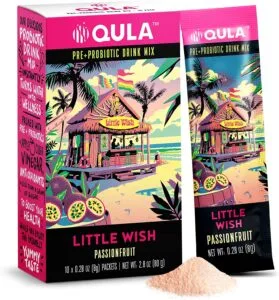
This nutritious drink mixture will enhance your everyday wellness regimen. Fortified with apple cider vinegar, antioxidants, genuine fruit, and live probiotics and prebiotics to enhance your daily wellness regimen. With natural ingredients, active probiotics, prebiotics, antioxidants from fermented tea, and pure apple cider vinegar, it promotes the health of the gut flora. Low-sugar, non-alcoholic, gluten-free, vegan, vegetarian, and keto-friendly. filled with fresh fruit and made with pure, quality ingredients. Single-serving sachets that are portable make it simple to eat on the go. One simple-to-open package should be added to 12 ounces of water. When ingested, every packet satisfies the strictest requirements for purity and potency. Store the fruit in a cool, dry location out of the direct sun to retain the live CFUs (colony-forming units), other natural components, and great flavor.
QULA Kombucha Drink Tabs, Probiotic Sugar Free Water Enhancer Tablet for Immune and Digestive Health Support
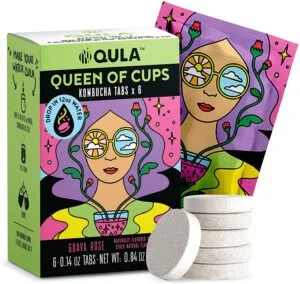
Put it in water and start brewing your own fresh kombucha! When you can just drop a tab into some water, let it brew, and then sip the deliciousness, you don’t need a bottle. Each drink features less than 1g of sugar, a ton of probiotics, and a special fermented tea and apple cider combination for a daily health boost (under 5 calories). Experience the Queen of Cups (Guava Rose), Upriser (Mango Pineapple), and Orange Mamba tastes, which are all refined and one-of-a-kind (Blood Orange Rosemary). Choose your favorite, then stock up! You’re consuming 98% less carbon dioxide by utilizing their tablets in conjunction with a glass or reusable water bottle than you would by purchasing and consuming bottled beverages. Refresh your water. alter the world.
Conclusion
A healthy gut requires both probiotics and prebiotics, which work together as a powerful one-two punch. Your whole health depends on keeping your gut healthy. “Gut bacteria assist to promote food absorption, fend off diseases, and current studies reveal that the bacteria in our intestines can directly alter our mood and our brain chemistry,” said Mackenzie McCune, an outpatient registered dietitian at Shore Medical Center. Clinical nutrition manager at Shore Medical Center Susan O’Donnell noted, “There are clear health advantages associated with digestion when persons have strong healthy bacteria in the stomach. Moreover, a healthy microbiome can improve constipation and reduce the need for antibiotics. Prebiotics are comparable to the stage crew preparing the stage for the actors to perform. Probiotics are the performers who can improve their performances with the help of the stage crew.