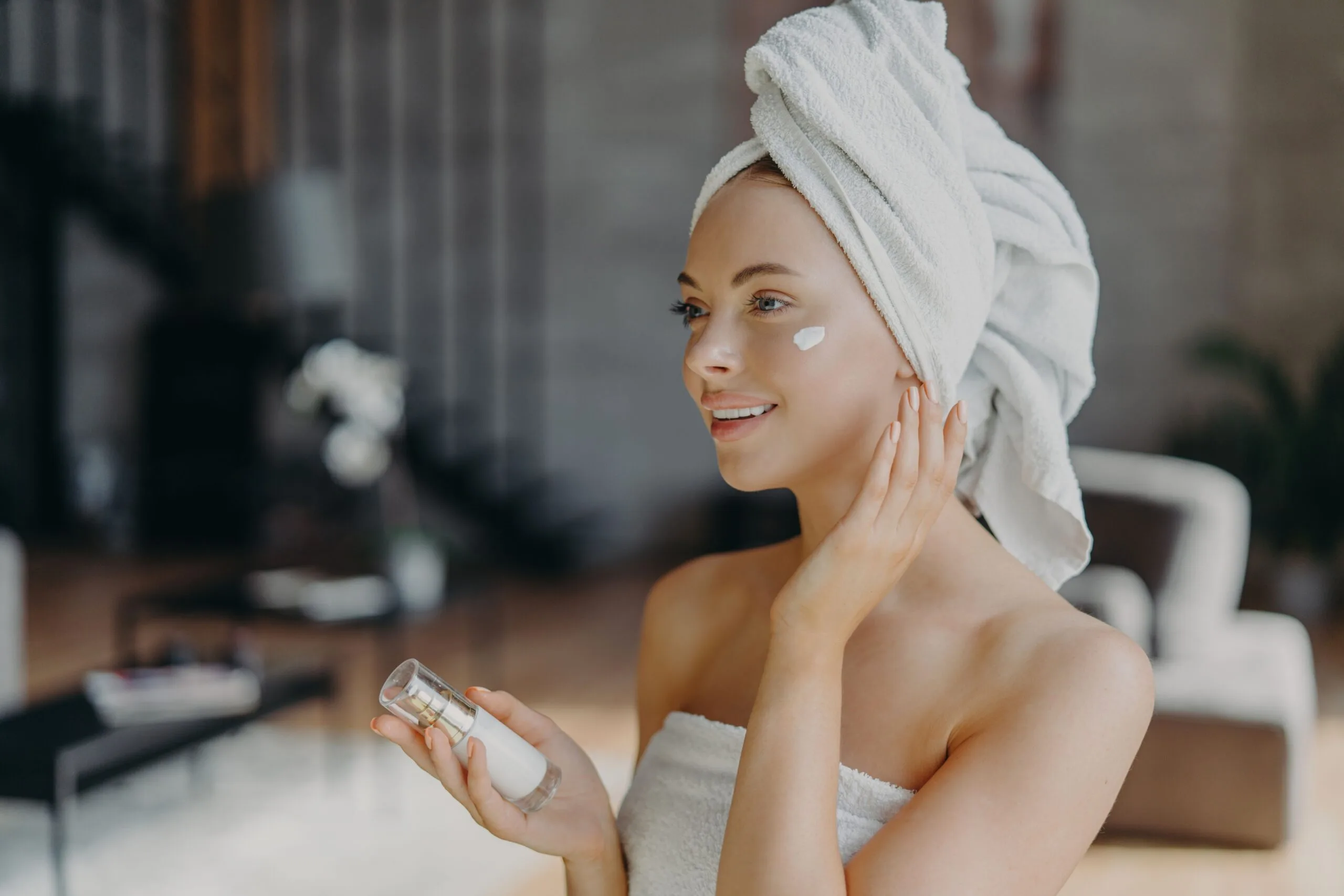


Her hand went first to the serum, then stopped. There was something she was supposed to remember about it. It had been recommended for a particular concern, but there was another product she had started using that week and, somewhere along the way, she had read that the two were better kept apart. She put the bottle back.
The cream seemed simpler. She picked that up instead, turned it over to check the label, then noticed the cleanser beside it. Had that one been the gentle one, or was it the other bottle? She stood there for a moment, reading instructions she had already read before.
Eventually, she washed her face, applied the moisturizer she knew her skin generally tolerated, and left the bathroom.
Her bathroom shelf had become a small archive of good intentions. There was a cleanser bought after someone mentioned it in passing, a cream reserved for particularly dry mornings, a serum with its own rules about timing, and a tube that had seemed essential at the time but was now permanently lying on its side. One bottle had been pushed so far behind the others that its label could no longer be read.
Skincare is often presented as a matter of adding: hydration, exfoliation, repair, protection, replenishment. Each concern can produce another bottle, another texture, another instruction about when and how to use it. For some people, particularly those with dry or sensitive skin, that accumulation can become less reassuring than it sounds. The more products enter a routine, the harder it can become to know what the skin is responding to, and what it is being asked to tolerate.

The Problem with Treating Skin Like a Blank Surface
The skin’s outer barrier has its own structure and function, helping to limit moisture loss while forming part of the body’s first line of defense against the outside environment. It isn’t just a surface waiting to be plied with another coat of the next product.
That makes the experience of dry skin strangely circular. The skin feels tight, so another layer is applied. It feels dry again, so another product is introduced.
The conventional lotion or cream is often largely water based. Water itself is not the enemy; hydration is fundamental to healthy looking skin, and water-based formulations can be perfectly appropriate for many people. But including water also affects how a product is formulated, including the need for other components to keep the finished formula stable and usable. For reactive skin, the formulation as a whole matters.
One consideration with water-free formulations is that removing water can also allow a formula to eliminate the need for certain surfactants and preservatives. Surfactants such as sodium lauryl sulfate can further strip the skin’s protective barrier of the lipids it needs to retain moisture, while preservatives are used to help keep water-containing products stable.
That makes water-free skincare less a rejection of conventional moisturizers than a different formulation strategy. The question becomes not whether water belongs in skincare, but what happens when a formula is designed without added water in the first place.
Questioning what needs to be in the formula is a more considered approach than simply adding another product.
2naturelle™, a skincare company, was founded by pharmacist Anh Thu Pham. With nearly three decades of pharmaceutical industry experience, Pham’s interest in natural products developed alongside her own experience with lifelong sensitive skin caused by eczema or atopic dermatitis. According to the company’s account of its origins, she spent years experimenting with essential oils and oil carriers, looking for combinations that would work comfortably with sensitive skin.
The resulting philosophy is described as “purposeful simplicity”: concentrated, plant-based formulations designed around the skin rather than around an increasingly elaborate ritual.
What Happens When Water Is Taken Out?
The most intriguing part of this philosophy is not that the formulas contain oils. Oils have long had a place in skincare. It is the decision to formulate without added water.
Primrose Nectar, for example, is described as a water-free moisturizer intended for very dry, sensitive and itchy feeling skin. Its formulation includes coconut, avocado, grapeseed, meadowfoam, hemp seed, argan and evening primrose oils, alongside vegetable glycerin and lavender essential oil. It is also formulated without added water, synthetic preservatives, dyes, artificial perfume, parabens, sulfates or animal-derived ingredients.
The practical detail is almost more interesting than the ingredient list.
Primrose Nectar is meant to be applied to clean, wet skin, ideally immediately after a shower or bath. One or two pumps are massaged into the damp surface, allowing the glycerin to interact with the water already present on the skin while the oils help seal that moisture in. The approach begins with moisture already on the skin rather than asking a cream to create the entire experience of hydration on its own.
Primrose Nectar is designed for the face, body and scalp, so one product can occupy several places in a routine that might otherwise involve several specialized bottles.
That does not make it a universal answer to every skin concern. Sensitive or chronically irritated skin can have individual triggers, and even plant-derived ingredients can cause reactions in some people. The product itself advises patch testing and avoiding contact with the eyes.


A Different Kind of Facial Oil
The same thinking appears in a more targeted form with 2Clear Facial Rejuvenation. Unlike a conventional cream, 2Clear is a facial oil built around a blend of plant oils, alongside glycerin, vitamin E, calendula and astaxanthin. It is positioned around supporting the skin barrier and improving the appearance of dryness, dullness and fine lines.
The oils in 2Clear were chosen specifically to provide the skin’s protective barrier with the lipids it may be missing, helping strengthen the barrier so it can better retain moisture. For 2Clear, the idea is particularly relevant to the drop in estrogen that can occur with menopause, when the body produces less of certain lipids. The selected oils are intended to provide those missing lipids to support the skin barrier.
The oil is red. That color comes from astaxanthin, the antioxidant that has become one of the more distinctive ingredients in the formulation. In the bottle, the color looks almost startlingly vivid. The application is deliberately ordinary: cleanse the face, leave the skin slightly damp, apply a few drops to the forehead and cheeks, then massage gently until absorbed.
The brand’s own account of its development places pharmaceutical experience alongside a sustained exploration of natural products in dermatology. That combination is important because “natural” on its own says relatively little. Natural ingredients are not automatically gentle, effective or suitable for every person. What gives this story its shape is the founder’s stated background in pharmaceutical research and the company’s emphasis on formulation.

The Luxury of Fewer Decisions
Perhaps the most relevant part of the idea has less to do with skincare than with contemporary life.
There is a particular kind of fatigue that comes from having to maintain too many small systems.
A meal plan, daily supplements, an exercise schedule, a sleep schedule, and the skincare routine are all small systems that need to be maintained. It is a different kind of tiredness: the accumulation of small decisions that never seem important enough to stop making.
Doing less is not necessarily neglect. Sometimes it means removing the parts that do not serve the central purpose. For someone with dry skin, the immediate priorities may be comfort and moisture retention. For someone trying to build a manageable daily ritual, it may also be consistency. A routine that takes only a minute and can be remembered may ultimately have more meaning than an elaborate ten step ritual that becomes too cumbersome to sustain.
A Simpler Routine Still Needs a Logic
Doing less does not mean abandoning everything at once. A useful place to begin is to look at what the skin is being asked to tolerate.
If the skin is dry, tight or easily unsettled, simplifying the routine can mean pausing newly introduced products, avoiding unnecessary layers and giving each formula enough time to show how the skin responds. A basic routine can often be organized around a few functions: gentle cleansing, moisturizing, and daytime protection from the sun. Anything beyond those basics has a reason to be there, rather than simply occupying another step.
There is also value in changing one thing at a time. When several products are introduced simultaneously, it becomes difficult to know which one is helping, irritating or simply making no noticeable difference. Keeping a short note of new products and how the skin feels over the following days can turn trial and error into something more considered.
For particularly sensitive or persistently irritated skin, simplicity should not replace professional advice. A dermatologist or other qualified healthcare professional can help distinguish ordinary dryness from a condition that needs specific treatment.
The point is not to count bottles. It is to make each one earn its place.

Returning to the Bathroom Shelf
Later, the bathroom shelf looks different. A few bottles have moved forward. Others have become less important. The routine has begun to make sense in relation to the moment when it happens: damp skin after a shower, a few drops worked between the palms, a little time before getting dressed.
The shelf does not have to be empty to feel different. A few bottles may still stand there, but the routine no longer asks for a daily negotiation. There is the cleanser, the moisturizer, the product that has earned its place because the skin responds well to it.
That may be the quieter luxury of simplifying skincare: not owning less for the sake of owning less but having fewer things to wonder about.
Earlier, her hand had hovered over the serum while she tried to remember what went with what. Now there is nothing to remember. She takes a shower, washes her face, reaches for what she needs, and gets on with her day. The shelf has not become empty. It has simply stopped making so many demands.