According to a new report from the Centers for Disease Control and Prevention, mosquitoes and ticks are mostly to blame for the more than threefold increase in vector-borne illness cases in the United States since 2004. Mosquitoes have long been known to transmit diseases like malaria and yellow fever, but more recently, they have also been linked to epidemic outbreaks of dengue, Zika, and chikungunya, mostly in U.S. territory. The insects are also primarily to blame for the West Nile virus becoming prevalent in the United States’ continental territory. Ticks, parasitic arthropods rather than insects, account for 76.51 percent of all instances of vector-borne disease in the United States, making them the main source of disease there. They include more recent illnesses as well as Lyme disease and Rocky Mountain spotted fever. By bites, both ticks and mosquitoes spread bacteria that cause illness. Nearly all tick life stages require blood to survive, while only the female mosquito consumes blood to create eggs. Although the capacity of mosquitoes to spread illnesses was first proved in 1889, mosquitoes have been doing so for much longer. There is evidence that humans in China were afflicted by malaria as early as 2700 B.C. Although there was a possible dengue epidemic in the early 1600s, it took three centuries for the first three mosquito-borne illnesses to reach the Americas: malaria, dengue, and yellow fever. Yet in only the last two decades, three new mosquito-borne illnesses—the West Nile, chikungunya, and Zika viruses—have emerged. A number of variables, including improvements in air and water travel as well as rising temperatures, are to blame for this pronounced increase in disease transmission.
The Price of Travel and Trade
The Asian tiger mosquito, Aedes albopictus, is now a world traveler thanks to the worldwide tire trade. Specifically, among the tens of thousands of tires on board these ships, this mosquito enters cargo ships and breeds in standing water accumulating in man-made containers. Breeding is great in the rainwater that collects in the tires. While not being a significant carrier of the dengue, chikungunya, or zika viruses, this invasive species is nevertheless particularly hazardous. It can outcompete the majority of mosquito species that inhabit comparable settings. Several vector-borne illnesses affect people as hosts, and our own mobility can facilitate transmission. In a few of hours, we may board an aircraft and go to another nation. Diseases that were formerly exclusive to certain parts of the world can now quickly spread within an affected person. Some people are ill and are completely unaware of it. According to research, up to 80% of Zika virus infections result in asymptomatic people. Nonetheless, transmission is still possible if the proper vector feeds on an infected but asymptomatic individual. Increasing climatic variability, which is primarily the result of human activities, can also impact the transmission of illnesses carried by vectors. Mosquitoes may be able to survive in regions that were previously too cold to support them in warmer temperatures. It might be challenging to predict how warming will affect all vector populations. Peak transmission and mosquito populations may move to the fall if, for instance, summer in the deep Southeast becomes too hot and dry for mosquito development. Warmer temperatures may hasten the process by which diseases grow within mosquitoes, hastening the period at which they become infectious and capable of spreading pathogens.
Tick-Borne Diseases
There are 900 different types of ticks, and five percent of them are known to carry pathogens. Researchers will likely identify additional tick-borne illnesses as humans have been reported to be bitten by 38% of all tick species. Seven of the nine novel vector-borne illnesses that have been reported in the United States since 2004 are tick-borne, including the potentially deadly Bourbon and Heartland viruses. The majority (82%) of tick-borne illness cases are Lyme disease, which is spread by the blacklegged tick, often known as the deer tick, and is brought on by the bacterium Borrelia burgdorferi. The prevalence of Lyme disease, Rocky Mountain spotted fever, babesiosis, anaplasmosis, and ehrlichiosis has multiplied. Due to increased travel, animal transportation, habitat fragmentation, and climatic change, tick-borne illnesses may be on the rise. Some significant tick species’ geographical expansion is associated with climate change. Formerly constrained by harsh winters, tick populations are increasingly expanding further north. The Public Health Agency of Canada created a Federal Framework on Lyme Disease in response to the introduction of the disease to Canada. This framework focuses on disease surveillance, education and awareness campaigns, and best practices for the management, prevention, and treatment of Lyme disease.
What if You Find a Tick On Yourself?
There is little to no chance of you becoming sick if you see a tick crawling on your skin and it hasn’t yet bit you. Only when it is connected and eating does a tick spread germs. Avoid touching one with your bare hands if you see one crawling! Avoid interacting with its mouthparts and ingesting the tick’s saliva, which might give you the flu. But, if you discovered one unattached tick, there’s a chance that another tick is moving on your body looking for a prime feeding location. Likewise, if you have a pet, it could have traveled on your clothing. Shower or take a bath when you return inside from the outside. As soon as you discover the tick, make sure to remove it correctly. The likelihood that it will spread Lyme disease increases with the length of attachment (studies show that other tick-borne illnesses are transmitted to your bloodstream in a matter of minutes). While there are a number of folk remedies for getting rid of ticks, such as putting petroleum jelly or nail polish on it or burning it with a match, you should ignore them all because they could agitate the tick and cause it to release body fluids into your skin, increasing the risk of disease transmission. Employ tweezers with a tiny tip or a specific tick-removal device like TickEase or TickKey. To remove the tick, grasp it as closely to your skin’s surface as you can and pull up while applying gentle, equal pressure. You might need to pull fairly firmly. Ticks are tiny, and nymph ticks can be as little as a poppy seed, so you’ll need to have a pretty tight grip. Avoid jerking or twisting the tick since doing so might frighten it and cause the mouthparts to break off and remain in the skin. Pull steadily up until the tick’s complete head and body are gone. When you pull the tick out, if the head breaks off, try to remove it with a pair of clean tweezers.
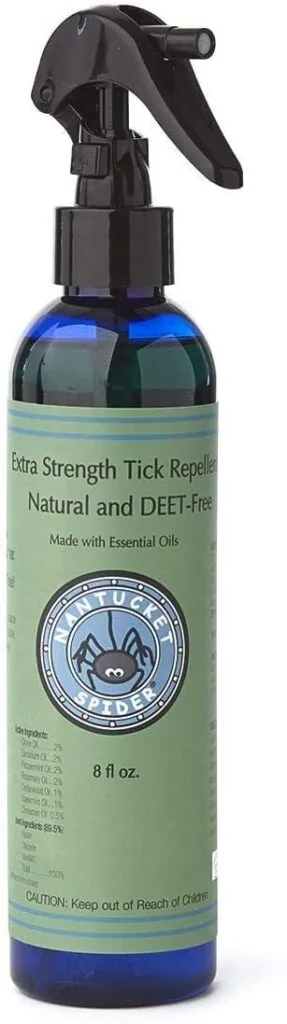
Nantucket Spider Extra Strength Natural Tick Repellent Spray
. The greatest natural tick repellent to use whenever you are in tick territory is Nantucket Spider Extra Strong Tick Repellant. Families will love the size of their 8-ounce container of the finest natural tick repellent, which has a fine-mist trigger sprayer on top for superior coverage. Ticks are effectively repelled by this product (in independent laboratory testing, it repelled 92% of deer ticks). It is made from a special combination of organic essential oils. Moreover, this item is DEET-free, soy-free, vegan, and cruelty-free. free of DEET, soy, veganism, and animal testing. The eco-friendly bottles are made from post-consumer recycled plastic.
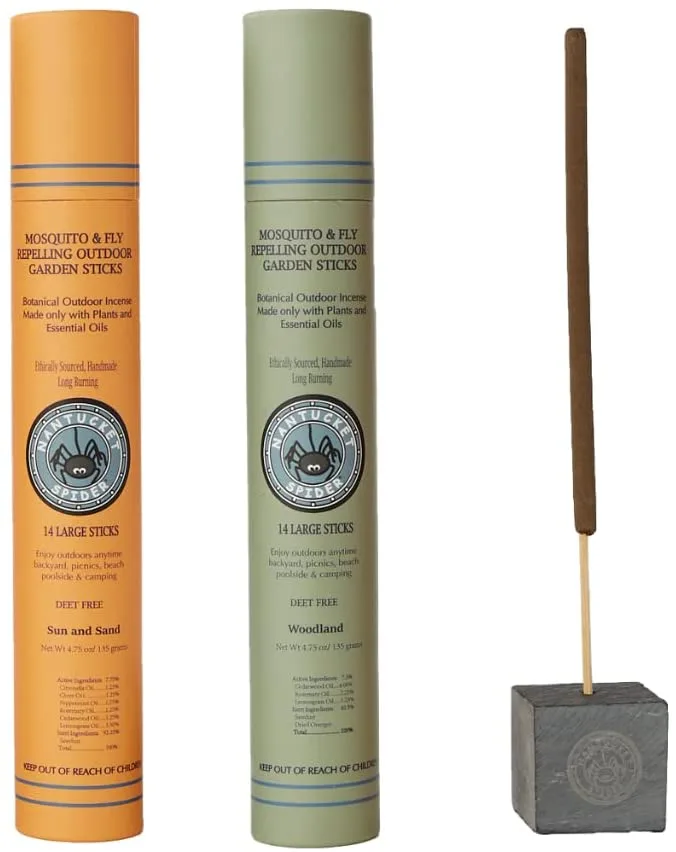
created using sawdust as a base, into which pure essential oils and dried herbs and plants are mixed. The four varieties include plant materials such as lavender flowers, orange peel, and coffee beans and essential oil blends including oils of geranium, cedarwood, rosemary, peppermint, citronella and lemongrass. These incense sticks are naturally fragrant and contain no artificial dyes. They are blended with the ideal combination of steam-distilled or cold-pressed essential oils, and they are exquisitely constructed. Each incense stick has a base made of sawdust, which makes it simple to light and keep lighted. Each stick offers more than 90 minutes of bug protection. They may also be easily put out of commission and relit for usage at other times.
Conclusion
The warmer weather brings out ticks, mosquitoes, and other bothersome insects. Insect repellents are frequently used by people to reduce their risk of being bitten by insects. They may not be aware of the advantages or disadvantages of their chosen repellant, though. It should be noted though that the Environmental Protection Agency does not allow minimum risk, natural repellents to make claims of their ability to prevent diseases.
Many insect repellents have the chemical DEET as their main constituent. There are conflicting claims about its safety. US government agencies consider DEET to be a safe alternative but allowable concentrations of this chemical is limited in Canada and in Europe . DEET can have an effect on the body’s central nervous system, according to studies. While the CDC’s position is that DEET is safe, it also acknowledges on its website that “occasionally, there have been reports of people having negative reactions after excessive use of repellents containing DEET. These effects included seizures, uncoordinated movements, agitation, aggressive behavior, low blood pressure, and skin irritation.” DEET has also been known to dissolve gear, waterproof clothing, cellphones, tents, and even boats!
Many consumers have chosen to seek a natural repellent alternative to DEET or other synthetic repellents. Knowing that natural repellents are better for your skin than synthetic ones should cheer up those with sensitive skin. Organic alternatives are gentler on the skin since they don’t contain harsh chemicals. With those with skin sensitivity to essential oils, water-based natural repellents such as Nantucket Spider can also be safely applied to hair, gear and clothing instead of directly on skin. The fragrance is much nicer and you won’t dread using it. Natural mosquito repellents are healthier for your body and have superior smells too!
With our eyes constantly glued to our smartphones, for many of us, the number one source of news is your With our eyes constantly glued to our smartphones, for many of us, the number one source of news.
With our eyes constantly glued to our smartphones, for many of us, the number one source of news is your With our eyes constantly glued to our smartphones, for many of us, the number one source of news.
With our eyes constantly glued to our smartphones, for many of us, the number one source of news is your With our eyes constantly glued to our smartphones, for many of us, the number one source of news.
With our eyes constantly glued to our smartphones, for many of us, the number one source of news is your With our eyes constantly glued to our smartphones, for many of us, the number one source of news.
With our eyes constantly glued to our smartphones, for many of us, the number one source of news is your With our eyes constantly glued to our smartphones, for many of us, the number one source of news.