
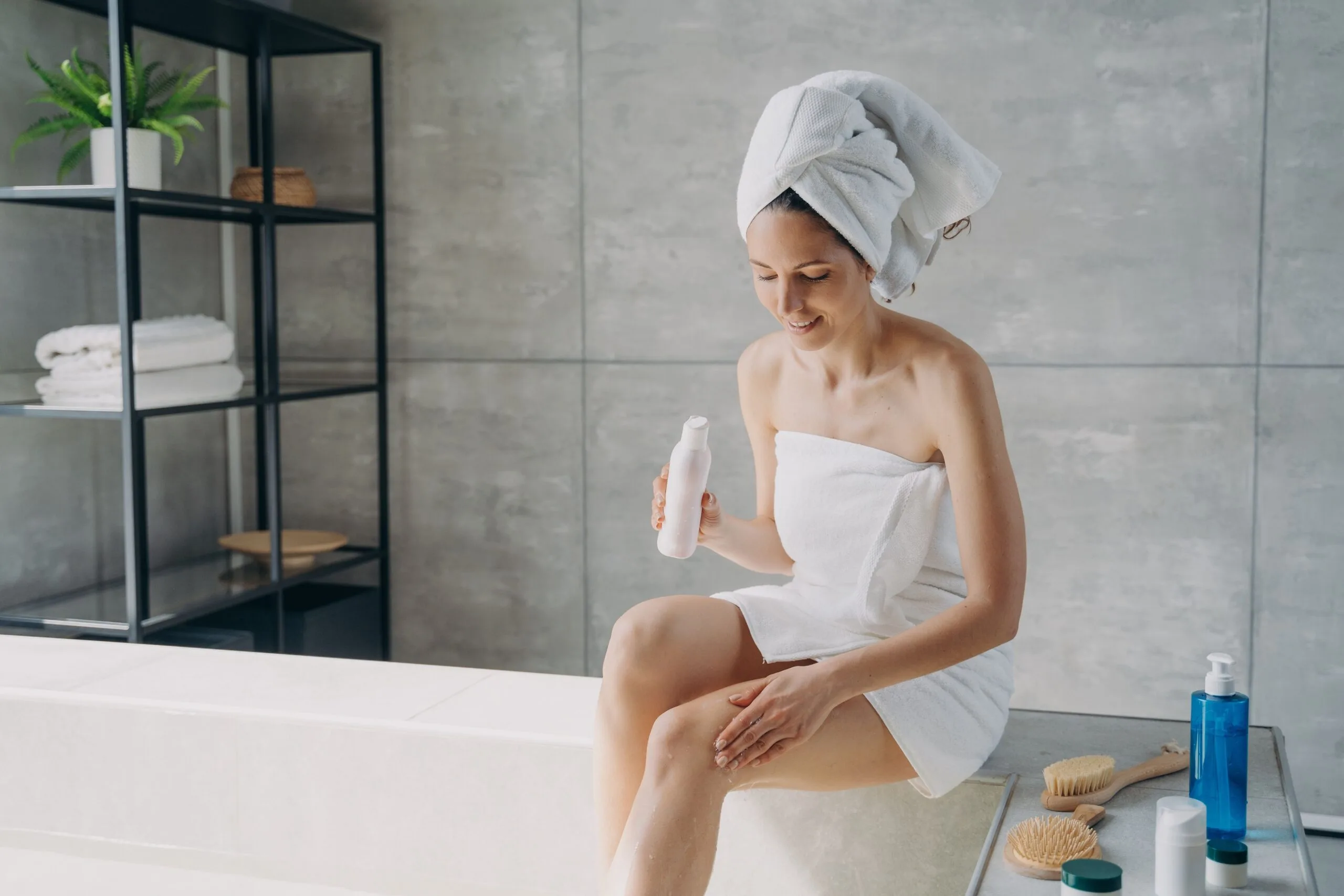
She was already in bed when she remembered the lotion.
Not the face cream. That had been done at the bathroom sink, somewhere between brushing her teeth and checking the weather for the next morning. The lotion was the one she had forgotten, sitting on the edge of the bath where she had left it after her shower.
For a moment, she considered leaving it there.
Her book was open beside her. The house was finally quiet. There were no more emails to answer, no dishes that urgently needed doing, no reason to get up again. The sensible thing, she decided, was to stay exactly where she was.
Then she thought about how dry her hands had felt all day.
So she got out of bed.
The bathroom was cold. She switched on the light, found the bottle, squeezed a little into her palm and began rubbing it into her hands. Then her wrists. Her elbows. She caught herself doing it quickly, the same way she had done almost everything else that day, as though even this small act of taking care of herself needed to be finished.
She stopped.
There was nowhere she needed to be.
That was the strange part.
She stood there for another moment, lotion warming between her palms, and wondered when something as ordinary as putting cream on your skin had become another item on a list of things you were supposed to do correctly.
When did taking care of ourselves become something we could fail at?
Somewhere along the way, self-care acquired its own standards. There was a right time to meditate, a better way to sleep, a more effective morning routine, a skincare regimen with enough steps to occupy an entire shelf. Even rest could feel like something that needed to be done properly.
Perhaps we have made the whole thing harder than it needs to be.
Perhaps care doesn’t always have to improve us, track us, fix us or lead somewhere.
Perhaps sometimes it can just be the lotion after the shower. The warm water running over tired shoulders. A little oil worked slowly into the hands. Ten unremarkable minutes in which nothing is being achieved.
There is something quietly radical about that kind of self-care.
It asks for our attention, not our optimization.

Who Has Time for a Perfect Routine?
The problem wasn’t the lotion. It was everything she had come to believe the lotion was supposed to accomplish. Somewhere along the way, even the smallest acts of care became attached to an outcome. Better skin, better sleep, less tension, and more energy. A better version of ourselves waiting on the other side of the routine.
We don’t necessarily need another routine to manage. We may simply need to notice the routines we already have differently. At the end of the day, there are already moments built into the ordinary things we do: applying body oil, taking a shower, getting ready for bed.
The shift is small. The action stays the same; only the attention changes. The lotion goes on the same way, but you notice the texture between your hands, the movement across your arms, the quiet repetition of rubbing it in.
Massage oil doesn’t require a spa setting. It can become part of the evening itself: a few minutes in which the day is allowed to become quieter.
Give Your Skin a Minute
Skincare can become part of a self-care ritual because it asks you to pay attention to something you usually move through without thinking. There is a small pleasure in warming lotion between your palms before it reaches the skin. The first pass is cool; the next feels warmer. You notice the dry places you hadn’t thought about all day: the knuckles, the elbows, the shins. None of this takes long. That may be precisely why it works.
That philosophy is reflected in Kay’s Organics LLC, a small-batch botanical skincare and wellness company founded by Kay, a registered nurse and herbalist in Missouri. Her background in nursing and herbalism has shaped the way she approaches ingredients and formulation.
The Dandelion Lotion with Shea Butter fits naturally into that kind of ritual. After a shower or before bed, it can become part of the small transition between doing and resting.
Sometimes the difference between a routine and a ritual is nothing more than the speed at which we do it.


The Forgotten Art of Touch
A massage is yet another thing that people may overlook. We spend so much time using our bodies during the day without really considering what they go through.
Think about what your hands have done by the end of an ordinary day. They carried grocery bags, turned keys, opened jars, typed messages, washed dishes, lifted things, held things, and perhaps spent hours curled around a steering wheel.
Massage creates a reason to stop, but it also brings us back to something that cannot be measured very easily: touch.
It could be a professional massage, someone you love rubbing your shoulder, or just spending a few minutes rubbing your own hands and feet. For a few minutes, there is nothing to measure or improve. There is only the movement of your hands and the sensation beneath them.
Kay’s Arnica and Calendula Massage Oil brings that idea into a more deliberate ritual, combining arnica and calendula with jojoba oil and vitamin E in a lightweight formula intended for massage.
But the experience of massage has little to do with ingredients alone. There is the scent, the slip of oil across the skin, the repetitive movement of the hands, and the simple fact that for a few minutes, your attention has somewhere to go.

Plants, Purpose, and a Little Perspective
Kay’s interest in botanicals began long before the brand existed. Alongside her work as a registered nurse, she also spent a lot of her time growing herbs, learning about their traditional uses, drying plants, and making her own infusions.
Her background places the botanical side of her work alongside a more conventional understanding of care, rather than in opposition to it.
There is something useful in refusing to make these interests compete with one another. A background in nursing doesn’t have to cancel out an interest in botanicals, just as an appreciation for plants doesn’t require abandoning what science can teach us about care.

Wellness is often considered another job or task to complete. There are routines to follow, habits to track, and endless advice about doing more. Perhaps the better question isn’t whether a ritual is effective, but whether it gives us a few minutes to be fully where we are, without asking anything more of ourselves.
There is still a day ahead of her, with its list of things to do, messages waiting to be answered and places she needs to go. The bottle hasn’t solved any of it.
The night before, she had stood in the cold bathroom with lotion warming between her palms and, for once, hadn’t hurried. She hadn’t been trying to sleep better, look better, recover better or become a more disciplined version of herself.
She had simply stopped.
Maybe that is the part of self-care we have forgotten: it doesn’t always have to take us somewhere.
Sometimes it can just bring us back to where we already are.