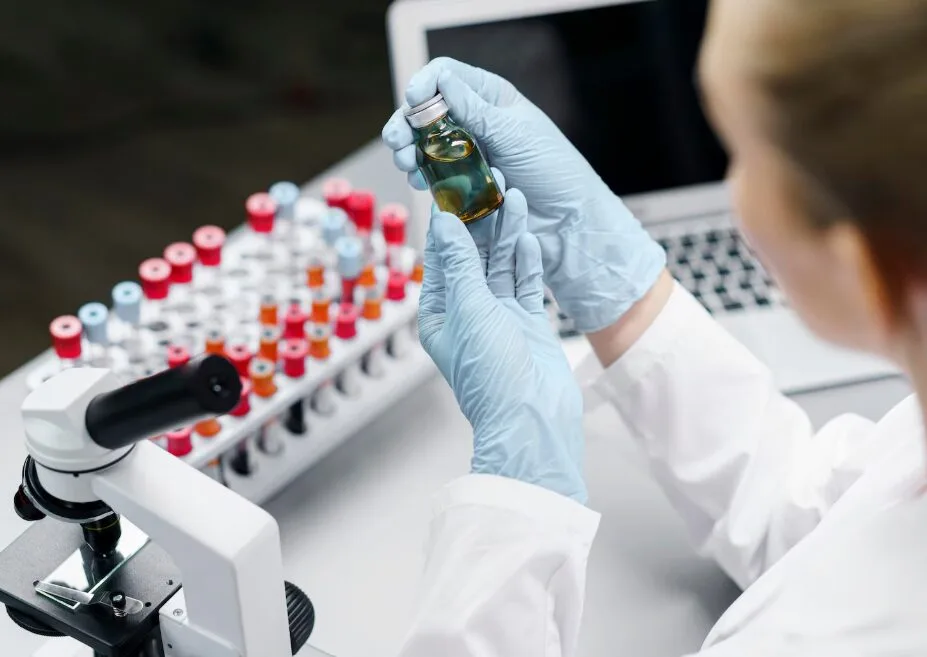


Most people encounter peptide science backwards: first comes the name, then the claim, and only afterward the question of what researchers actually know. That question matters because peptides don’t fit neatly into one wellness story. They are being investigated across different biological pathways, from metabolism and receptor signaling to skin biology and cellular activity.

Peptides Speak a Language of Their Own
Spend enough time around peptide research, and you’ll quickly realize that the names can be almost as intriguing as the science behind them. While one compound gains traction because of the receptors it interacts with, another may be studied for its relationship with cellular signaling, and another may be studied in areas such as skin biology or tissue remodeling.
If you’re not immersed in laboratory research, peptides can feel extremely complicated.
Imagine a researcher examining a new compound on a screen, comparing one pathway with another and asking what might happen when several biological signals are viewed together. There is no dramatic breakthrough in that moment, just another question, another experiment, and another piece of information added to a much larger picture.
In a scientific sense, the quality of research materials also matters. Researchers need to fully understand what they are working with. Clear and precise documentation, batch information, and analytical testing can make a major difference when the goal is to understand a compound.
Reserve Research is a brand that focuses on research-grade peptides and compounds. They place a great emphasis on third-party testing, batch-specific Certificates of Analysis, transparency, and straightforward access to research information. Their compounds are supplied exclusively for in-vitro research and laboratory purposes instead of being offered for human or veterinary use.
If researchers are going to investigate such sophisticated compounds, then the materials that aim to support that world should also be treated with great attention to detail.
From Metabolism to Skin Biology
The current selection includes two compounds that serve as a demonstration of just how wide the peptide research landscape can be: a triple agonist and GHK-Cu.
While both of these compounds have found their place within the world of peptides, the questions researchers ask about each one are remarkably different.

This triple agonist is often looked at within metabolic research because of its interaction with three receptor pathways: GIP, GLP-1, and glucagon.
A 2023 Phase 2 trial published in the New England Journal of Medicine looked at the compound in adults who were navigating obesity. The trial reported that there was a substantial reduction in body weight over a 48-week period. This study is important because of the compound’s triple-agonist approach. Importantly, clinical research should not be confused with research-use-only materials.
This triple agonist is attracting growing attention as Phase 3 research progresses, but it remains an investigational compound, with important questions still being explored. For researchers interested in the material itself, the current listing describes it as a synthetic triple-receptor agonist peptide involving GIP, GLP-1, and glucagon receptor activity. It is offered as lyophilized material, with independent third-party analytical testing, batch-specific Certificates of Analysis, and 5 mg, 10 mg, and 30 mg sizes listed.
When looking at the other compound, you’ll notice that the conversation jumps in a completely different direction. GHK-Cu is a small copper-based peptide that has been within the research realm for many years. Research has examined GHK-Cu in areas including skin biology, cellular activity, and repair-related biological processes. GHK is naturally found within the body, while GHK-Cu is its copper-bound form. Researchers continue to investigate how it may function in cosmetic and biological applications.
Interesting research is not the same as proven results. Sometimes, the most honest conclusion science can offer is that more research is needed. The brand’s current listing describes this compound as a copper-bound tripeptide complex in research-grade lyophilized powder, with independent third-party testing and a batch-specific Certificate of Analysis. It is currently listed in 50 mg and 100 mg sizes.

When the Details Change, the Results Can Change Too
Here’s where peptide research gets particularly interesting: two studies can examine what sounds like the same compound and still produce very different results.
The difference may come down to the details: how the peptide was prepared, how it was measured, the experimental model used, the dose or concentration, or what outcome researchers were actually looking for. Even the quality and consistency of a research reagent can influence reproducibility. Scientific literature has highlighted the importance of well-characterized peptide and protein materials for producing reliable experimental results.
That is worth remembering when a new study appears to contradict an older one. A different result does not necessarily mean that one researcher was wrong. Sometimes the experiments are answering slightly different questions.
For anyone following peptide science, this is where the story becomes more interesting. The compound itself is only part of the equation. The model, the method, the material and the question being asked all shape what researchers are able to learn.
In other words, peptide science is not simply about finding an exciting molecule. It is about figuring out exactly what happens when that molecule is placed under carefully defined conditions.
The Unseen Work of Peptide Research
Research isn’t exactly the most exciting thing about peptides, but testing matters. Even when an experiment seems routine, researchers still need to understand exactly what they are working with. Consistent batches, independent testing, and clear documentation can help researchers determine whether differences in their results reflect the biology being studied rather than differences in the material itself.
Reserve Research makes transparency part of its approach, providing batch-specific testing information and purity results with its listings. They also make failed batches available for viewing rather than only showcasing successful results.
A failed batch can be informative, too. In research, quality control is not only about confirming what meets a specification; it is also about identifying material that does not.

The Next Question Matters
Peptide research is growing quickly, and scientists are exploring these compounds from different angles, focusing on metabolism, skin biology, and cellular signaling. While some compounds show a lot of exciting potential, others may help scientists understand something new.
For Reserve Research, the focus is on providing research compounds as well as testing information and clear documentation. Their products are to be used for research only and not intended for human or veterinary use, diagnosis, or treatment.
And so, that brings us back to a single idea: ask a question, learn from the results, and then move on to the next question.
As peptide research continues to evolve, it’s time to consider that curiosity may be more valuable than the hype that surrounds it.