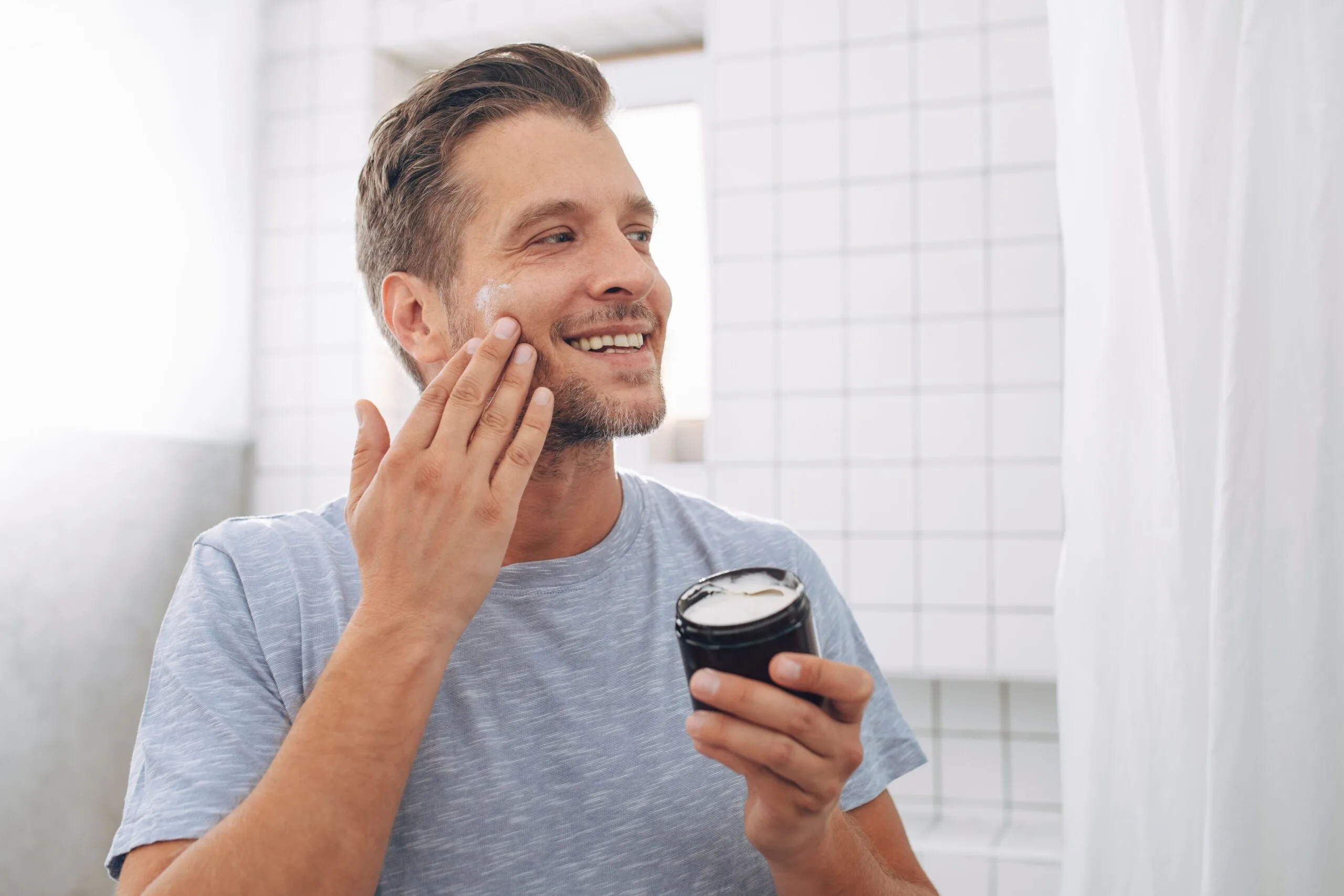


One morning your skin feels calm. Two days later it feels tight, shiny, and dry at once. Nothing in your bathroom changed. Yet somehow your face no longer seems to follow the rules it used to.
There’s a point where skin stops responding the way it used to. Your moisturizer that used to work now feels like it disappears too quickly, daily routines that once gave clarity now leave things slightly uneven, and it isn’t really that your complexion is “bad”; it has just become harder to read.
If you’ve ever looked in the mirror and wondered why your trusted routine suddenly stopped working, you’re not imagining it.
This kind of sudden shift is often described as “skincare not working anymore,” but the cause is usually less about products and more about environmental and lifestyle load on the skin.

Skin Doesn’t Fail, It Starts Filtering Differently
The modern skin environment is not neutral. Every day, your skin processes layers of input ranging from temperature shifts to pollution particles, UV exposure to emotional stress, sleep disruption to product layering, and dietary fluctuations to hormonal cycles. Each of these places a different kind of demand on the skin, and it is constantly working to respond and rebalance.
Think about how different your skin feels after a sleepless night compared with a quiet weekend spent outdoors. Nothing dramatic changed overnight, but your skin received a very different set of signals.
The problem begins when signals stack faster than the system can stabilize them. Your skin doesn’t “break” in response, priorities change.
Some mornings your skin feels tight by lunchtime. Other days it feels oily for no obvious reason. Your forehead becomes shiny while your cheeks still feel dry. Makeup stops sitting the same way from one week to the next.
What you call “skin issues” are often just delayed system responses under overload. The skin is still working, just not clearly.
When those responses become inconsistent, it’s easy to assume your skin has changed. More often, it’s the environment around your skin that has become noisier.
The Real Problem Isn’t Skin Type
Most skincare is built around correction. You add moisture for dryness, if your pores are congested you cleanse more often, and you exfoliate to relieve the dull appearance. When your skin doesn’t look the way you expect, it’s easy to assume something has gone wrong. In reality, your skin may simply be processing more competing signals than it can respond to efficiently.
Imagine trying to follow several conversations at once, eventually everything becomes noise rather than meaning. Skin behaves in a surprisingly similar way. When it is responding to pollution, stress, UV exposure, shifting weather, and layered skincare all at once, its responses become less precise. The issue isn’t that your skin has stopped working. It’s that it’s working through too much information.
Adding more products eventually worsens the situation because you are effectively adding to the “static”. Your skin doesn’t need more stimulation; it needs the interference to be reduced.
You’ve had those weeks when nothing in the bathroom changes, yet your skin behaves like it belongs to someone else. Your morning routine feels normal, but by midday your T-zone is already shining through makeup. Or your skin feels fine at night, but wakes up tight and uneven for no obvious reason. The cleanser is the same. The serum is the same. Even the weather hasn’t changed much. But sleep has been inconsistent, meals have been rushed, deadlines have piled up, and suddenly your skin feels impossible to predict. That’s often less about needing a different routine and more about needing fewer competing signals.

Black Seed Oil as a Low-Noise Biological Input
Life Essence Black Seed Oil is one of those rare inputs that behaves less like a cosmetic step and supports the appearance of balance. It doesn’t “activate” the skin, it stabilizes how it responds.
Pressed from Nigella sativa, black seed oil carries a naturally complete lipid profile made up of omega-6 and omega-9 fatty acids, antioxidants, and thymoquinone. Its strength lies in how naturally its composition aligns with the skin’s own lipid environment.
Rather than forcing exfoliation, stimulating rapid turnover or pushing the skin in a particular direction, black seed oil works more quietly. Its strength lies in making the skin’s responses more consistent over time.
On the scalp, this can help support a less reactive, more balanced-feeling environment over time. On the face, it behaves differently from most oils. It doesn’t sit heavily, and it doesn’t vanish instantly either. It helps support a more stable surface response over time, helping hydration feel more stable across hours instead of fluctuating quickly. On the body, it works in areas where friction accumulates: elbows, knees, and hands. It does this by reducing the sharp contrast between dry and hydrated states. Even nails respond by becoming less brittle over time.
The key is consistency. Rather than targeting a single concern, black seed oil helps maintain consistency across multiple areas of the skin.
When the Skin Needs a Reset Point
Life Essence Mineral Dead Sea Mud Mask introduces a different kind of intervention that temporarily reduces surface noise so the skin can recalibrate its own output. The skin does not accumulate toxins in a literal sense; it tends to accumulate surface buildup and environmental residue:
- Excess surface sebum linked to imbalance
- Environmental particulate buildup
- Layered product residue
- Uneven keratin buildup from slowed turnover
Dead Sea minerals like magnesium, calcium, and potassium interact with the skin in a way that supports surface equilibrium. They help lift and remove excess surface buildup more effectively
Coconut charcoal adds adsorption capacity, binding to surface irregularities that contribute to congestion patterns. Bentonite clay, formed from ancient volcanic ash, contributes structural absorption and gentle exfoliation support.

As the mask dries, external buildup is reduced, leaving the skin with fewer competing surface influences and making its natural balance easier to restore.
Why Modern Skin Feels “Unstable”
There’s a misconception that skin problems are becoming more common, but a more accurate way to describe it is that skin environments have become less stable. You layer more products than ever before. You answer emails before breakfast, spend hours in air-conditioned offices, move between heated rooms and outdoor humidity, and often finish the day with far less sleep than our skin would prefer.
The skin adapts to all of this, but adaptation comes at a cost: reduced predictability. That’s why two people can use the same product and get completely different results. It’s not just “skin type.” It’s system context.
From Correction to Clarity
Once you shift the goal from correction to clarity, everything changes. The question changes from: “What can fix this?” to “What reduces noise?” Clarity is, after all, about restoring the skin’s ability to interpret inputs without distortion. This is where simpler ingredients outperform overly complex formulations. They are less contradictory.
Black seed oil doesn’t introduce competing signals. Mineral mud doesn’t stack new instructions. One stabilizes. One resets. Together, they create a rhythm the skin can actually follow.
Life Essence and the Logic of Relational Ingredients
The philosophy behind Life Essence Natural Health Products is not built around isolating single “active” compounds for maximum impact. It is built around keeping naturally occurring compounds together, allowing them to work as they do in nature, rather than isolating a single ingredient.

Nature rarely works through single molecules acting alone. Plants are collaborative systems, and their compounds evolved to work together. In whole botanical systems, compounds don’t act independently. They modulate one another, balancing intensity, buffering reactions, and distributing function across multiple pathways.
Life Essence formulations behave differently from high-isolation skincare systems because they preserve that internal relationship.
What Happens When the Skin Stops Compensating
When signal interference decreases, the skin stops overreacting. Hydration doesn’t swing between extremes. Texture becomes less volatile. Response time improves. The skin is no longer compensating for confusion. Most visible “issues” are not static conditions, they are compensations. When compensation is no longer necessary, the system settles on its own.
The Quiet Advantage of Less Interference
There is a modern assumption that better skincare must mean more advanced skincare, but biological systems don’t necessarily respond better to complexity. They respond better to clarity which is achieved through subtraction rather than addition.
Black seed oil simplifies how the skin behaves over time. Mineral mud simplifies how the skin behaves in the moment. One reduces long-term variability. One reduces short-term interference. Neither tries to “fix” the skin. Both allow it to function without distortion.

Skin as a Signal System
Perhaps your skin has been misunderstood all along. Rather than treating it as a surface that constantly needs correcting, it makes more sense to see it as a responsive system that performs best when the signals it receives are clear. When those signals are less chaotic, the skin regulates itself more efficiently.
Life Essence Natural Health Products doesn’t believe in more intervention. The brand is rooted in the belief that less interference and clearer conditions is the ideal environment for your skin to thrive.
Modern skincare often assumes that healthier skin comes from adding more. Sometimes the opposite is true. When the noise quiets down, the skin doesn’t need instruction. It returns to its own rhythm.